Jining Maxpower Machinery Co., Ltd.




Imagine two inquiries arriving at a rental desk on the same morning. One customer needs a machine that can enter a narrow backyard. Another wants an excavator for a small building site with considerably more room.
Both ask for a mini excavator. Supplying the same machine to both customers would still require separate checks.
For a rental company, a new excavator should solve a recognizable gap in customer demand. It should also fit the way the business delivers equipment, prepares machines between bookings, and supports operators.
The MAXPOWER ME35.9 Stage V is one option to assess. This guide looks at its published specifications through a rental buyer’s questions, rather than treating a larger bucket or higher power rating as sufficient reason to expand the fleet.
Before discussing an order, review the inquiries your business could not fulfill.
Separate requests declined because every machine was booked from those declined because your equipment was unsuitable. Buying another unit may address availability. Buying a different configuration should address a different requirement.
Look closely at the customer’s actual task. Did the job need more excavation capacity, a different working range, or access your existing machines could not provide?
Use those records to define the role of the proposed machine. A mini excavator rental fleet becomes easier to manage when each size has a clear purpose, rather than several models competing for the same bookings.
MAXPOWER’s ME35.9 Stage V product page lists an operating weight of 3.75 tonnes, a 0.12 m³ bucket, and a 3TNV88F engine rated at 17.3 kW at 2,200 rpm. These are the published figures for the version discussed here.
Use them to establish a candidate configuration. They do not demonstrate rental demand, fuel consumption, or long-term availability.
For a rental purchase, the next question is whether that configuration matches the jobs you expect to book. Give MAXPOWER examples of those jobs and request the corresponding working-range and operating information before approving the machine.
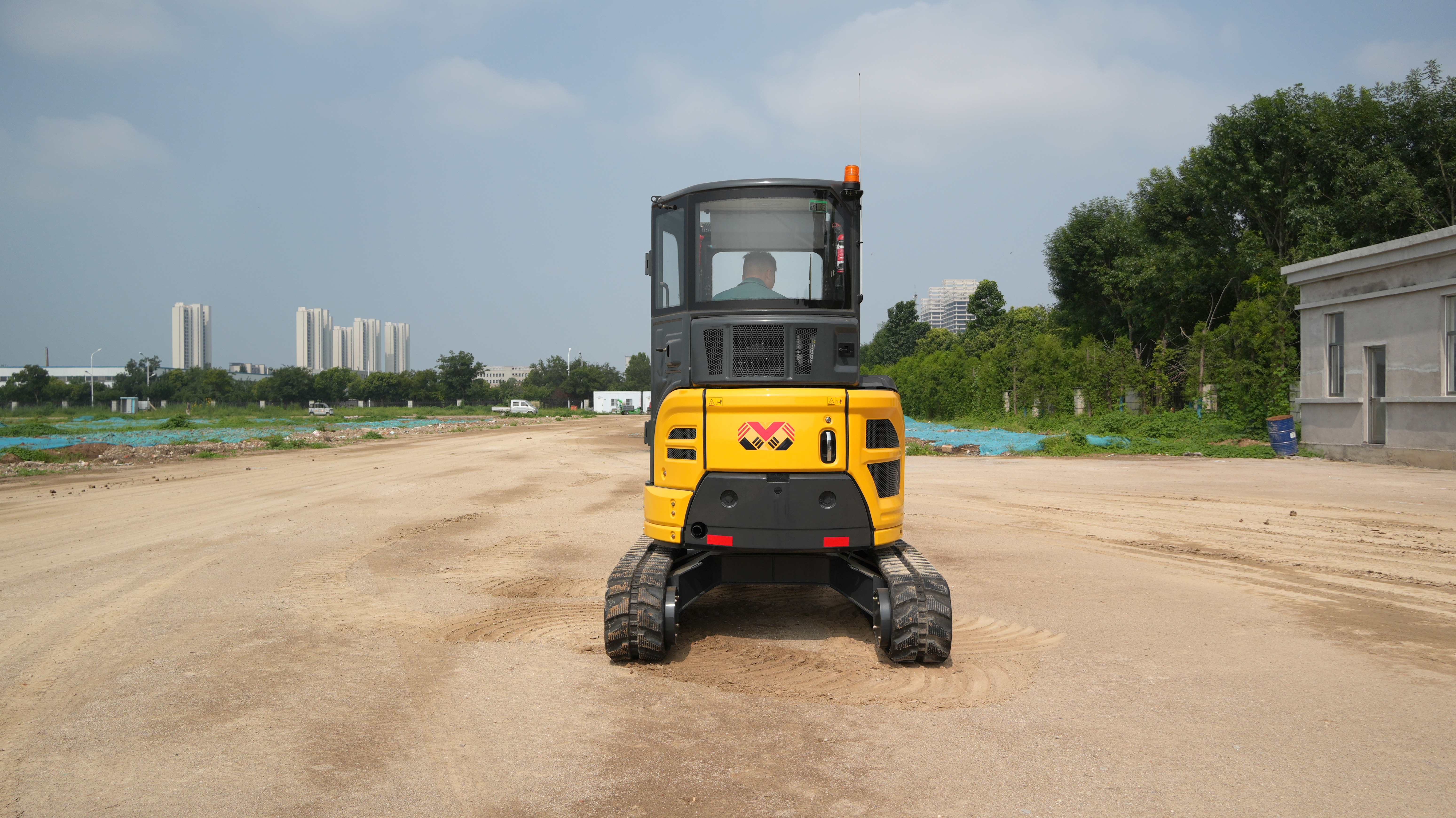
The ME35.9 has a published overall width of 1,740 mm, length of 4,800 mm, and height to the top of the cab of 2,560 mm.
Those dimensions should be available to your booking team. A customer asking for a machine to pass through a narrower opening needs a different option, not reassurance based on the word “mini.”
Entrance access is only the first check. The machine also needs room to operate. HSE’s excavator guidance treats clearance, operator visibility, and pedestrian exclusion as separate considerations.
Build the booking conversation around the full route and work area. Request measurements or photographs when the customer’s description is unclear.
Assess delivery before committing to fleet expansion.
Ask your transport provider to review the exact machine configuration, supplied equipment, and proposed carrying arrangement. Do not select a trailer from an approximate machine-class description.
Then examine your dispatch schedule. Would delivering the ME35.9 require a different vehicle from the one used for your smaller machines? Could collection and delivery be combined efficiently? Would the new machine compete with existing equipment for the same transport slot?
These are operational questions, not arguments against a larger rental unit. They help determine whether your business can make the equipment available when customers need it.
A purchase should fit the delivery operation as well as the customer’s excavation task.
Ask for a demonstration based on a job your customers regularly request.
Define the material, excavation dimensions, and intended spoil location. Have a competent operator complete the agreed task while your team observes from a designated safe position. HSE emphasizes trained operators, suitable visibility, and keeping people outside the excavator’s operating area.
Record completed work and elapsed time, but also note the questions a customer would ask. Can the operator see the relevant work area? Does the machine need repeated repositioning? Which instructions require explanation before use?
A demonstration should help your team decide which bookings to accept. It should not become a promise that every customer will reproduce the same output.
Do not build the rental offer around the assumption that a compact machine is suitable for an inexperienced operator without appropriate training.
HSE’s training and competence guidance explains that training needs depend on the equipment, the task, existing competence, and working circumstances.
Before purchasing, ask MAXPOWER for the operating instructions and the information needed for a machine-specific handover.
Prepare your own dispatch process around those documents. Establish how staff will explain the supplied controls, approved operating procedures, inspection responsibilities, and defect-reporting arrangements.
A brief collection-yard demonstration should not be represented as complete operator training. Customers need both the necessary competence and familiarity with the particular machine supplied.
Plan the return-to-ready process before the first rental begins.
Identify who receives the machine, records its condition, reviews reported problems, and decides whether it can return to service. Keep cleaning and presentation separate from the inspection needed to establish safe operation.
HSE’s work-equipment inspection guidance recommends determining inspection scope and frequency through risk assessment, taking account of manufacturer recommendations. It also addresses inspection evidence accompanying equipment transferred between businesses, including hired equipment.
Use that principle to develop a process appropriate to your market and operation. Do not invent one universal inspection interval for every rental.
The purchasing decision should include whether your team has the information and competence to carry out that process consistently.
Consider standardizing the equipment that your customers request most often.
Ask MAXPOWER to identify the supplied bucket, operator-station equipment, controls, and other agreed items. Retain the approved configuration so later orders can be checked against it.
Standardization does not mean adding every possible option. It means avoiding unexplained differences between machines that your booking team presents as equivalent.
For example, when two units are offered under the same rental description, staff should know whether their dimensions, operating instructions, or supplied equipment differ.
Keep additional configurations separate where they serve a distinct customer need. The goal is a rental offer your team can explain accurately—not a catalog containing the largest number of variations.
Discuss a realistic service situation before ordering.
Suppose a customer reports a warning and your mechanic cannot identify the cause from the operating documentation. Establish who receives the report, what information is required, and how further diagnosis will be arranged.
Request the parts-identification information and recommended service materials for the delivered configuration. Ask for written warranty terms applicable to the intended rental use.
Use MAXPOWER’s service contact to clarify the arrangements for your location. Do not assume that a general support statement establishes local stock, a particular response time, or coverage for every kind of rental damage.
The useful outcome is an agreed process your team can follow when a booking is at risk.
Make that decision the responsibility of suitably competent personnel, using the machine’s instructions and your inspection arrangements.
HSE recommends daily visual checks, scheduled inspections, and prompt attention to reported defects. Its excavator guidance states that a machine should be withdrawn from service when a defect is safety-critical.
For rental operations, this means the next reservation must not determine whether a problem is acceptable.
Create a clear status for equipment awaiting assessment. Dispatch staff should be able to distinguish a machine being cleaned from one that has not been cleared for further use.
That distinction protects the customer and prevents uncertainty from being passed to the next operator.
A staged introduction is worth considering when the model or size is new to your fleet.
Use an initial machine to evaluate customer fit, delivery arrangements, handover quality, and workshop preparation. Define the questions before deployment so the assessment does not become a collection of unrelated comments.
Record which bookings the machine fulfills and why customers select it. Also record declined requests, support calls, and time between return and readiness.
Look for evidence of genuinely additional demand. If the ME35.9 mainly takes bookings previously completed by another available machine, investigate whether it is expanding your offer or simply redistributing existing work.
Those observations provide a stronger basis for the next order than assuming that the first busy week represents a normal year.
Shortlist it when your actual inquiries indicate a need that its confirmed configuration may satisfy.
Keep smaller machines available for customers whose access restrictions exclude the ME35.9. Evaluate other excavator classes when the work requires capabilities that have not been established for this model.
Compare candidates through MAXPOWER’s excavator range, but give each one the same customer brief. Ask how the proposed configuration meets that requirement.
The best addition to a mini excavator rental fleet is the machine that fills an identifiable gap and can be supported reliably—not simply the newest model offered.
The ME35.9 should be evaluated as a rental asset with a defined role.
Use its actual specifications to screen customer requirements. Then assess delivery, demonstration results, operator handover, inspection, and service arrangements before expanding the order.
A well-supported machine that consistently suits the bookings you accept is more useful than one purchased on headline specifications alone.
MAXPOWER lists 3.75 tonnes for the ME35.9 Stage V. Confirm the supplied configuration when arranging transport.
No. Assess actual customer inquiries and the work they need completed rather than using bucket capacity as a demand forecast.
A handover does not replace appropriate training and competence for the equipment and task.
Track suitable bookings, delivery requirements, customer feedback, support calls, and time needed to prepare the machine for its next rental.
HSE guidance addresses providing evidence of the latest inspection when equipment requiring inspection passes between businesses. Check the requirements applicable to your operation.
Share your common customer jobs, access requirements, delivery arrangements, and workshop capabilities with MAXPOWER. Request the ME35.9 technical information and discuss a configuration that your rental team can supply and support.