Maxpower Construction Machinery Manufacturer




A quotation that says “standard tires included” leaves an important purchasing question unanswered: standard for what kind of work?
A backhoe loader might spend most of its day crossing a paved yard, or it might alternate between loose fill, gravel access roads, and loading areas. Before ordering, the buyer needs to know exactly which tires will arrive with the machine and whether the proposed configuration suits that working pattern.
For contractors and distributors evaluating the MAXPOWER MEL880A, backhoe loader tire sizes are the starting point. The purchasing decision should also address load requirements, operating conditions, replacement compatibility, and local service support.
This is not about buying tires separately from the machine. It is about avoiding an incomplete equipment specification.
The official MEL880A product specification lists 14-17.5 front tires and 19.5L-24 rear tires. Both engine-option columns show the same tire-size entries.
Keep the front and rear designations separate in your inquiry and purchase documentation. Do not shorten the requirement to “construction tires” or assume the machine uses the same size at both ends.
Ask for the complete identification of the tires included in the offer. Retain photographs of the delivered sidewall markings with the machine record so your maintenance team has a reliable reference when replacement becomes necessary.
Size compatibility is necessary, but it does not answer every suitability question.
The tire and wheel must be compatible as an assembly. OSHA’s rim-wheel servicing standard, for workplaces within its scope, specifically addresses checking tire and wheel size and type before assembly.
For a purchase, ask the supplier to confirm the approved tire-and-wheel combination, along with the applicable load and operating information.
If a quotation offers an alternative tire, request its technical details before accepting the substitution. A matching size designation should not be the only evidence used to approve it.
“It fits the wheel” and “it suits the machine’s work” are different questions.
Avoid sending only an industry label such as “construction” or “agriculture.” Describe the route the machine will actually follow.
For example, your proposed operation might involve loading gravel in a compacted yard, travelling along an unpaved access road, and excavating beside a newly prepared building area. Another customer might remain almost entirely on an established hard surface.
Send photographs showing representative conditions, including the less favorable parts of the route. Explain whether the machine regularly encounters sharp debris, deeply rutted areas, or seasonal changes in surface condition.
Ask MAXPOWER to assess the proposed tire configuration against that description. Do not request a different tread simply because it looks more aggressive in a photograph.
The MEL880A specification lists 8,800 kg operating weight and 2,500 kg rated load capacity in the loading section. These are machine and loader figures—not individual tire load ratings.
Do not divide operating weight by four and use the result as a tire specification. That calculation assumes an equal distribution without establishing the actual loading conditions.
Describe the materials you expect to handle and how the loader will be used. Ask for the approved operating limits and tire information applicable to that work.
Keep bucket volume, loader rating, axle loading, and tire capacity distinct. Combining unrelated figures into one apparent “capacity” creates a comparison that may look precise but does not support the purchase.
Do not select an inflation pressure from a generic online answer.
The MEL880A page lists 27 MPa as system pressure; this is not a tire inflation setting. The public table does not provide an approved front-and-rear tire-pressure schedule.
Request the pressure instructions for the actual supplied tires and machine configuration. Have your maintenance team review the information before handover, including the specified checking conditions and any distinctions between operating tasks.
If the documentation is unclear, resolve that with the supplier rather than filling the gap with a value used on another backhoe loader.
A written, configuration-specific instruction is far more useful than a verbal assurance that “the usual pressure will be fine.”
Not on its own.
MAXPOWER publishes a 34–39 km/h maximum-speed range for the MEL880A. That machine specification should not be treated as authorization for every load, route, or replacement tire.
Explain the travel pattern when requesting the configuration. Is the machine making short movements between a stockpile and a work area, or does the project require longer transfers?
Ask the supplier to identify the applicable operating restrictions. Where public-road travel is proposed, have the relevant local requirements checked separately.
The point is not to choose the tire configuration around the highest speed in the brochure. It is to confirm that the complete machine is appropriate for the movement you intend to perform.
Arrange a representative demonstration with a trained operator and an appropriately controlled work area.
Instead of watching only excavation, include the approach to a material pile, a permitted loading movement, turning, and repositioning. Record the surface condition and machine configuration so the observations remain useful afterward.
Look for questions rather than trying to conduct an improvised tire test. Does the proposed route require repeated corrections? Is the working area suitable for the movement? Does the operator identify any restrictions that affect your planned task?
Do not ask for deliberate wheelspin, overloading, or unusual maneuvers to “prove traction.” A purchasing demonstration should show how the machine performs approved work under relevant conditions.
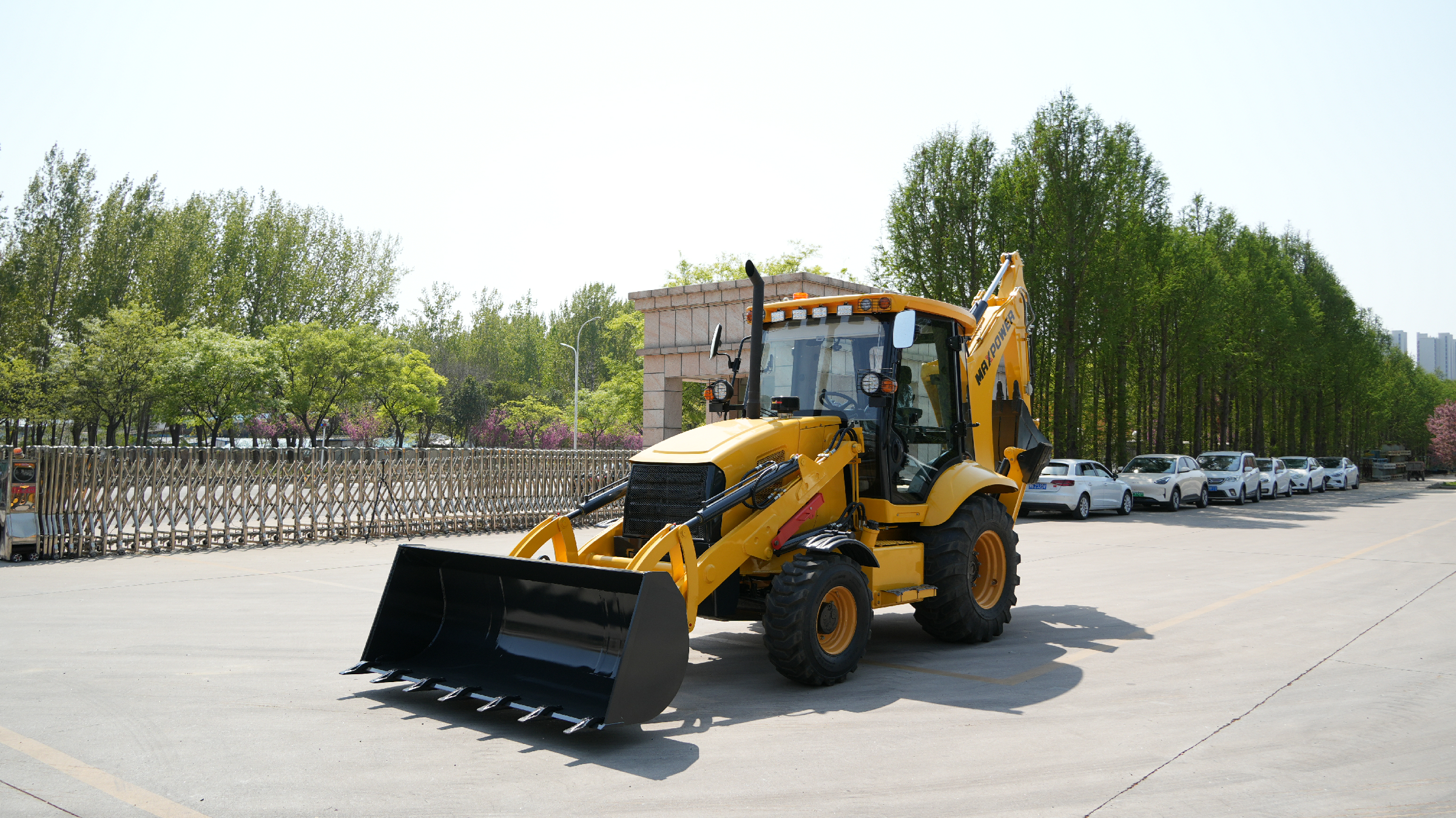
Treat a proposed change as an equipment-compatibility decision, not simply a parts purchase.
Before approving a replacement or alternative configuration, provide the machine identification and the complete tire and wheel details to the manufacturer or an appropriately qualified specialist.
OSHA’s rim-wheel guidance emphasizes compatibility and warns against interchanging wheel components except as allowed by the applicable charts or manuals.
Do not assume that a configuration used on another backhoe loader is suitable for the MEL880A. Equally, do not assume every locally available tire with a similar designation is an approved substitute.
Resolve the question before ordering replacement stock. That is easier than discovering an incompatibility after the machine has been taken out of service.
Include it in your equipment review, especially when the machine will operate far from your main workshop.
Send the confirmed tire specification to your intended local service provider. Ask whether it can source an approved replacement, identify the correct wheel assembly, and perform the required work.
Do not assume availability from the size code alone. Obtain an actual response for your location and the proposed specification.
For a distributor, repeat this assessment for the markets you serve. A tire arrangement that is straightforward to support in one country may require a different supply plan elsewhere.
The outcome should be a practical replacement route, not merely a promise that parts can eventually be ordered.
Agree this before delivery.
Commercial tire and wheel servicing requires appropriate competence and equipment. OSHA’s standard covers employee training, relevant manuals, and protective arrangements for the wheel-servicing work within its scope. It also identifies hazards associated with the release of pressurized air and wheel components.
Use a qualified service provider and follow the instructions applicable to the supplied assembly. Requirements differ by workplace and jurisdiction, so confirm those relevant to your operation.
During handover, distinguish the operator’s approved inspection responsibilities from tire removal, mounting, or repair. Do not leave an inexperienced operator to improvise because the machine has developed a tire problem at a remote site.
Record the front and rear tire sizes, the complete supplied tire identification, and the agreed wheel configuration. Request the applicable operating and pressure information with the machine documentation.
Also clarify how substitutions will be handled. If the supplier proposes a different tire before dispatch, review the supporting information rather than accepting it solely because the size is unchanged.
For multiple-machine orders, keep one approved configuration record for each arrangement. This helps purchasing staff compare quotations and gives the receiving team a clear basis for checking delivery.
When reviewing alternatives in MAXPOWER’s backhoe loader range, use the same site description and workload for each comparison. Otherwise, differences in the quotations may reflect different assumptions rather than different machine suitability.
Backhoe loader tire sizes deserve more attention than a single line reading “standard tires.”
For the MEL880A, start with the published front and rear sizes, then confirm the complete configuration against your loading tasks, travel pattern, working surfaces, and service arrangements.
The useful purchasing outcome is straightforward: you know what will be delivered, how it is intended to operate, and how your team will support it. That is a stronger basis for ordering than choosing tires from appearance or size alone.
MAXPOWER lists 14-17.5 front tires and 19.5L-24 rear tires.
No. It is listed as system pressure, not a tire inflation setting. Request the applicable tire-pressure instructions separately.
Do not assume so. Confirm tire-and-wheel compatibility and suitability for the machine’s approved operating conditions.
Describe the working surfaces, loading tasks, travel pattern, project location, and available local service support.
Compare the delivered tire markings and configuration with the approved order, and confirm that the relevant operating and maintenance information is included.
Send MAXPOWER your site photographs, material-handling requirements, and expected travel pattern. Use the MEL880A product inquiry to request a confirmed tire configuration before finalizing your equipment order.







