Maxpower Construction Machinery Manufacturer




Municipal construction and maintenance projects require equipment that can handle a wide range of tasks without creating unnecessary complexity on the job site. From repairing water pipelines and excavating sewer trenches to maintaining roads and clearing drainage channels, municipal contractors often need one machine that can move quickly between different applications.
This is where a backhoe loader becomes particularly valuable. By combining a rear excavator with a front loader, it can perform digging, trenching, loading, material handling, and site cleanup with one machine.
MAXPOWER Backhoe Loaders are designed for contractors, municipalities, utility companies, and infrastructure service providers that need reliable equipment for diverse municipal applications. Their versatility makes them suitable for both planned construction projects and routine maintenance work.
Municipal projects cover a much broader range of activities than conventional building construction.
A city maintenance department may need to repair a damaged water line in the morning, excavate a drainage trench in the afternoon, and remove construction debris later the same day.
A backhoe loader can support these different tasks without requiring several specialized machines.
Common municipal applications include:
Water pipeline maintenance
Sewer construction
Drainage excavation
Roadside maintenance
Utility trenching
Street repair
Landscaping
Material loading
Snow or debris removal
Public facility maintenance
This versatility is one of the main reasons backhoe loaders remain popular among municipal contractors.
Municipal work is often unpredictable.
Large infrastructure projects may have carefully planned schedules, but maintenance teams frequently respond to changing conditions. A damaged pipeline, a blocked drainage channel, a damaged roadside, or an emergency excavation may require immediate deployment of equipment.
A versatile backhoe loader allows contractors to respond without waiting for several different machines to arrive.
This can be especially important for municipalities responsible for maintaining large geographic areas.
Instead of maintaining a separate excavator and loader for every small project, a backhoe loader can perform multiple functions with a single machine.
Yes. Utility trenching is one of the most common applications for backhoe loaders.
Municipal infrastructure contains extensive underground networks, including:
Water pipes
Sewer lines
Electrical cables
Communication cables
Gas infrastructure
Stormwater systems
When contractors need to repair or install these systems, they must excavate trenches while maintaining control around existing infrastructure.
The rear excavator attachment of a backhoe loader provides the digging capability needed for these applications.
For smaller and medium-sized utility projects, a backhoe loader can provide an efficient alternative to deploying a dedicated excavator.
Sewer construction requires controlled trench excavation and efficient material handling.
Contractors need to excavate to the required depth, remove soil, prepare the trench, and later backfill the excavation.
A backhoe loader can support many of these activities.
The rear bucket excavates the trench, while the front loader can move excavated soil, aggregate, and other materials around the work site.
This combination reduces the need to constantly move equipment between different stages of the project.
For municipal sewer maintenance, this flexibility can significantly improve daily productivity.
Effective drainage is essential for maintaining roads, public spaces, and urban infrastructure.
Blocked or poorly designed drainage systems can lead to flooding, erosion, pavement damage, and infrastructure deterioration.
Municipal contractors use backhoe loaders for:
Drainage ditch excavation
Stormwater channel construction
Culvert installation
Drainage pipe preparation
Ditch cleaning
Flood-control maintenance
The ability to excavate and handle materials with one machine makes backhoe loaders particularly useful for drainage maintenance.
Yes. Municipal road maintenance is another important application.
Unlike large-scale highway construction, city road maintenance often involves smaller work areas and frequent changes between tasks.
A backhoe loader can support:
Roadside excavation
Shoulder repair
Pothole preparation
Drainage maintenance
Utility repairs
Material loading
Debris removal
Its relatively compact operating footprint also makes it suitable for many urban maintenance environments.
For municipalities managing numerous small projects, machine versatility can be more valuable than maximum excavation capacity.
This is an important equipment selection question.
A dedicated excavator generally provides greater excavation performance, reach, and digging capability. It is the better choice for large foundations, deep excavation, major earthmoving, and heavy-duty construction.
A backhoe loader, however, is designed around versatility.
It can excavate with the rear attachment and immediately switch to loading or material handling with the front bucket.
A backhoe loader may therefore be more suitable when municipal projects involve:
Frequent task changes
Smaller work areas
Utility maintenance
Roadside repairs
Drainage work
Material handling
For large excavation projects, a dedicated MAXPOWER excavator may be more appropriate. For multi-purpose municipal maintenance, a MAXPOWER Backhoe Loader can provide greater operational flexibility.
Urban maintenance creates several equipment challenges.
Construction teams may need to work close to:
Buildings
Traffic
Pedestrians
Utility networks
Existing roads
Public facilities
The equipment must therefore provide a balance between working capability and maneuverability.
A backhoe loader can move between different municipal work sites and perform multiple tasks without requiring a large equipment fleet.
This flexibility is particularly useful for contractors working on short-duration maintenance projects.
Choosing a backhoe loader for municipal work requires more than looking at basic engine specifications.
Hydraulic performance affects digging speed, attachment control, lifting capability, and overall operating smoothness.
For utility and drainage projects, precise hydraulic control is particularly important.
The front loader needs to handle soil, aggregate, debris, and other common municipal materials efficiently.
Buyers should evaluate digging depth, reach, bucket configuration, and hydraulic performance based on their most common projects.
Municipal work frequently takes place in restricted areas. A machine that can move efficiently around existing infrastructure provides greater practical value.
Operators may spend long hours performing repetitive maintenance tasks.
Good visibility and a practical operating environment can improve productivity and help reduce operator fatigue.
Municipal equipment needs to remain available when required.
Easy access to service points can simplify routine maintenance and help reduce unnecessary downtime.
The key advantage is the machine's two-function design.
The rear excavator attachment can handle digging and trenching.
The front loader can handle loading and material movement.
Depending on the machine configuration and available attachments, additional tools can further expand its capabilities.
This means a contractor can use one machine for a sequence of related tasks.
For example, during a municipal water pipeline repair, a backhoe loader can:
Excavate the access trench.
Remove soil from the working area.
Assist with material handling.
Prepare aggregate for backfilling.
Backfill the excavation.
Clean the work area.
This reduces equipment changes and helps crews maintain workflow continuity.
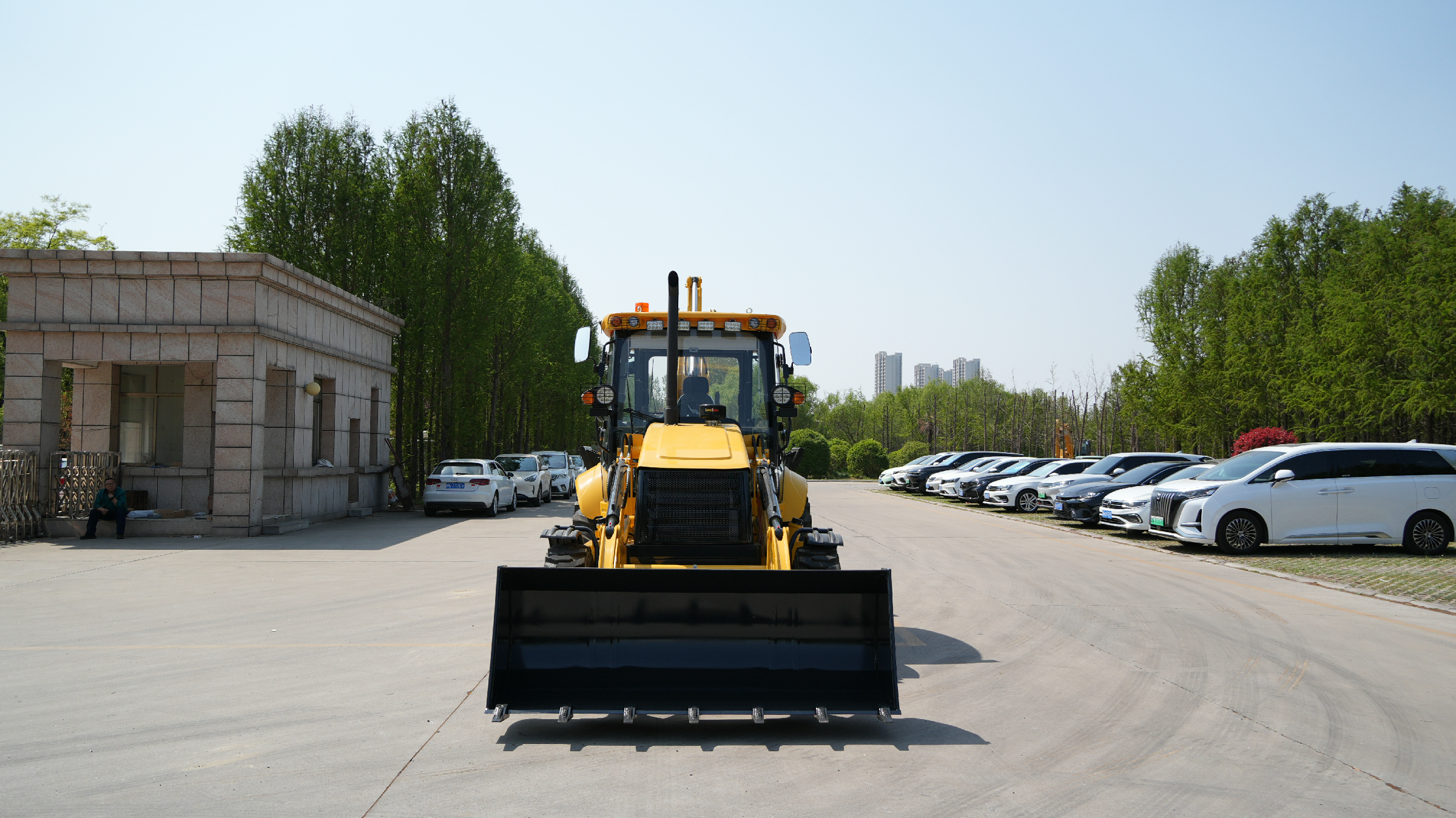
Municipal contractors need machinery that can perform consistently across different applications rather than equipment designed for only one specific task.
MAXPOWER Backhoe Loaders are developed around this requirement.
They provide a combination of excavation and loading capabilities that can support:
Municipal infrastructure
Utility maintenance
Sewer projects
Drainage construction
Road maintenance
Public works
General site preparation
MAXPOWER's broader construction equipment portfolio also includes Excavators, Specialty Excavators, Electric Excavators, Specialty Equipment, and Rotary Drilling Rigs, allowing contractors to select equipment according to different project requirements.
For buyers managing multiple types of infrastructure projects, this broader equipment portfolio can simplify equipment sourcing and project planning.
A backhoe loader is not the best solution for every municipal project.
A dedicated excavator may be preferable when the project requires:
Deep excavation
High excavation volumes
Long digging reach
Heavy-duty earthmoving
Large foundation excavation
Continuous excavation operations
For example, a major underground infrastructure project may require a dedicated excavator because excavation productivity is the primary requirement.
However, if the municipal contractor needs to perform excavation, loading, material handling, and maintenance with the same machine, a backhoe loader may provide greater versatility.
The correct choice should always be based on actual project requirements.
Equipment utilization is an important consideration for contractors managing multiple projects.
A machine that remains idle for long periods reduces fleet efficiency.
Backhoe loaders can help improve utilization because they are suitable for many different tasks.
Instead of limiting the machine to excavation, contractors can use it for loading, trenching, drainage maintenance, road repairs, landscaping, and general site preparation.
This makes the machine useful across a wider range of projects throughout the year.
MAXPOWER Backhoe Loaders can be considered for a wide range of municipal applications.
These include:
Excavation for water pipelines, valve chambers, and repair areas.
Trench excavation, soil removal, backfilling, and site cleanup.
Drainage channels, culverts, ditches, and flood-control maintenance.
Roadside excavation, shoulder work, drainage repairs, and material handling.
Landscaping, site preparation, and general earthmoving around public facilities.
This broad application range makes backhoe loaders particularly useful for contractors whose work changes from project to project.
Before purchasing, buyers should first identify their most common applications.
Ask the following questions:
What type of work will the machine perform most frequently?
If utility trenching and drainage dominate, excavation capability should receive greater attention.
How much material needs to be moved?
If loading is a major part of daily work, front-loader capability becomes more important.
Where will the machine operate?
Urban sites may require greater maneuverability than open construction sites.
How many hours will it operate each day?
Long operating schedules require careful consideration of machine durability, maintenance, and operator comfort.
Will additional attachments be required?
Attachment compatibility can significantly expand the machine's long-term usefulness.
These questions help buyers choose equipment based on actual operating conditions rather than specifications alone.
Municipal projects require construction equipment that can adapt to constantly changing requirements. From water and sewer maintenance to drainage construction, road repair, and utility trenching, contractors often need to perform several different tasks within a single workday.
A backhoe loader provides a practical solution because it combines excavation and loading capabilities in one machine.
MAXPOWER Backhoe Loaders are designed to provide reliable performance and versatility for municipal contractors, utility companies, infrastructure service providers, and public works projects.
For buyers looking for a machine capable of handling multiple municipal applications, choosing the right backhoe loader can improve equipment utilization, simplify jobsite operations, and support more efficient project execution.
A backhoe loader is mainly used for excavation, trenching, loading, material handling, drainage construction, utility installation, and general site maintenance.
Yes. Backhoe loaders are commonly used to excavate sewer trenches and can also assist with material handling and backfilling operations.
Yes. It can support roadside excavation, drainage repair, shoulder maintenance, material handling, and other municipal road maintenance activities.
A backhoe loader combines a rear excavator with a front loader, while a dedicated excavator focuses primarily on excavation and heavy digging.
Choose based on the project. A backhoe loader is generally better for multi-purpose work, while a dedicated excavator is more suitable for large-scale or deep excavation.
Yes. Its front and rear attachments allow it to switch between excavation, loading, trenching, material handling, and site cleanup.
Consider excavation depth, loader capability, hydraulic performance, maneuverability, operating environment, maintenance accessibility, attachment compatibility, and expected working hours.
MAXPOWER Backhoe Loaders are designed to provide versatile excavation and loading capabilities for municipal infrastructure, utility, drainage, road maintenance, and general construction applications.







