Maxpower Construction Machinery Manufacturer




Urban construction projects create some of the most demanding conditions for excavation equipment.
Unlike large open construction sites, urban jobs often involve limited working space, existing buildings, underground utilities, traffic restrictions, noise requirements, and strict project schedules.
A machine that performs well on a large earthmoving project may not be the best choice for city construction.
For contractors, municipal companies, utility providers, and equipment buyers, selecting the right excavator for urban construction requires more than looking at engine power or operating weight.
The ideal machine needs to balance digging performance, compact dimensions, maneuverability, transportation efficiency, attachment flexibility, and reliability.
This article explains the key factors contractors should consider when choosing an excavator for urban construction projects.
Urban construction sites are different from traditional construction environments.
Space is often limited.
A contractor may need to excavate beside existing buildings, work between roads and sidewalks, operate near underground pipelines, or complete repairs without interrupting surrounding activities.
These conditions create several challenges:
Limited machine access
Restricted operating space
Increased safety requirements
Difficult material removal
Noise and emission concerns
Frequent equipment repositioning
Because of these limitations, a successful urban excavation project depends heavily on selecting equipment that matches the site conditions.
A powerful excavator is not always the best excavator.
A machine that can enter the site, operate efficiently, and complete the required work safely often provides better overall productivity.
The best excavator for urban construction depends on the specific application.
For smaller city projects, compact and mini excavators are often preferred because they can operate in narrow areas and require less transportation space.
For larger urban infrastructure projects, medium excavators may provide the additional digging capacity needed for foundations, road construction, and utility installation.
Contractors should consider:
Available working area
Required digging depth
Material type
Project duration
Transportation limitations
Attachment requirements
The correct machine size is not necessarily the smallest machine that fits the site.
It is the machine that can complete the work efficiently without creating unnecessary operational challenges.
Compact excavators have become increasingly important for urban construction because they solve many access problems.
Their smaller dimensions allow them to work in locations where larger equipment cannot operate effectively.
Common applications include:
Residential construction
Landscaping
Utility repairs
Sidewalk installation
Underground pipe work
Road maintenance
Building renovation
A compact excavator can often enter narrow areas, operate close to existing structures, and reduce the need for manual labor.
For contractors working on multiple small urban projects, compact equipment can improve machine utilization because it is easier to transport and deploy.
Excavator size directly affects productivity, mobility, and operating cost.
A larger excavator usually provides:
Greater digging force
Higher lifting capacity
Larger bucket options
Longer working range
However, urban construction often creates limitations.
A large excavator may struggle with:
Narrow streets
Limited access points
Restricted jobsite space
Transportation restrictions
A smaller excavator may complete the work more efficiently because it can operate where larger machines cannot.
The goal is not to choose the largest machine available.
The goal is to choose a machine that provides enough performance while maintaining jobsite flexibility.
Maneuverability is one of the most important factors in city construction.
Urban sites often require frequent machine repositioning.
An excavator may need to work around:
Buildings
Vehicles
Construction barriers
Utility structures
Pedestrian areas
A machine with good control and compact dimensions can reduce unnecessary movement and improve productivity.
For contractors, maneuverability directly affects cycle time.
A machine that spends less time adjusting position can spend more time performing productive excavation work.
Urban construction rarely involves only one type of excavation.
Different stages of a project may require different attachments.
Common excavator attachments include:
Standard digging buckets
Hydraulic breakers
Augers
Grapples
Tilt buckets
Compaction attachments
For example, a contractor repairing underground utilities may use a bucket for excavation and then switch to another attachment for additional site preparation.
Attachment compatibility is therefore an important consideration when purchasing an excavator.
A machine with strong hydraulic performance and flexible attachment options can support more applications throughout its service life.
Utility work is one of the most common urban excavation applications.
Projects involving water pipes, electrical systems, drainage, telecommunications, and gas infrastructure often require precise excavation in restricted areas.
The excavator should provide:
Accurate control
Suitable digging depth
Good visibility
Compact operation
Reliable hydraulic performance
In many cases, the contractor is not moving thousands of cubic meters of soil.
The challenge is completing precise excavation while protecting surrounding infrastructure.
This is why equipment control and maneuverability can be just as important as maximum digging force.
Electric excavators are becoming increasingly attractive for certain urban applications.
Cities often have stricter requirements regarding:
Noise levels
Exhaust emissions
Environmental impact
Electric excavators can provide advantages in areas such as:
Indoor construction
Underground projects
Residential areas
Noise-sensitive locations
However, contractors should evaluate practical factors before choosing electric equipment.
Important considerations include:
Daily operating hours
Charging availability
Project schedule
Battery capacity requirements
Working environment
MAXPOWER offers electric excavator solutions designed for applications where reduced emissions and lower noise operation are important considerations.
You can explore the Electric Excavators range for urban and specialized construction requirements.
Transportation is often overlooked when selecting construction equipment.
In urban environments, contractors may need to move machines between multiple locations quickly.
A machine that requires complicated transportation arrangements can increase project costs and reduce efficiency.
Compact excavators typically provide advantages because they are easier to transport between job sites.
However, larger urban projects may justify medium excavators because their higher productivity can offset transportation requirements.
Contractors should evaluate the complete operating cycle:
Transportation time
Setup time
Excavation productivity
Daily utilization
The cheapest transportation option does not always create the lowest total project cost.
Urban excavation requires careful safety planning.
Construction sites often contain hidden risks, including underground utilities, nearby structures, public access areas, and limited operating space.
Equipment selection can support safer operation.
Important features include:
Good operator visibility
Precise hydraulic control
Stable machine design
Appropriate working dimensions
Reliable safety systems
However, the excavator itself is only one part of site safety.
Proper planning, utility detection, operator training, and compliance with local regulations remain essential.
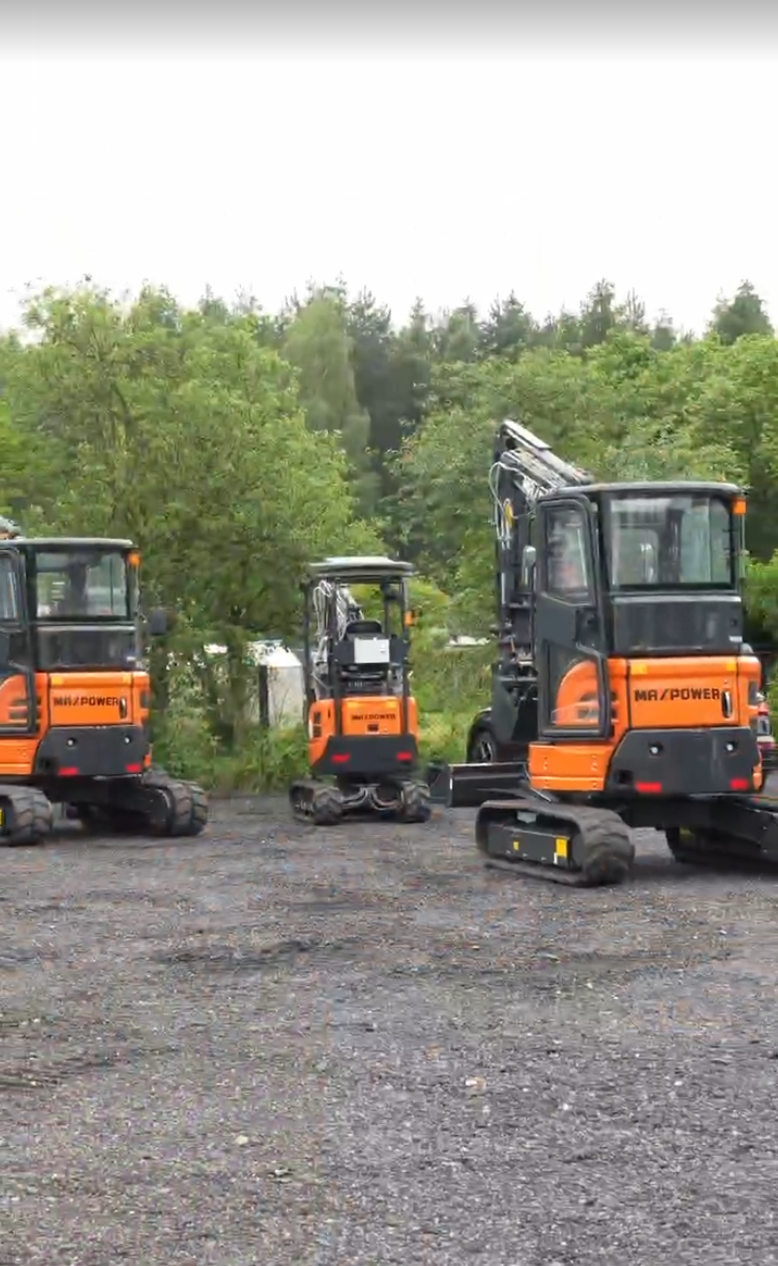
Productivity in urban construction is not only about digging speed.
A productive excavator should minimize downtime and maximize working hours.
Several factors can improve performance:
An oversized machine may create access problems.
An undersized machine may require excessive working cycles.
The correct balance improves efficiency.
The right attachment can significantly improve performance for specific tasks.
Experienced operators understand how to position the machine, manage loads, and reduce unnecessary movements.
Unexpected downtime can seriously affect urban projects with tight schedules.
Preventive maintenance helps avoid delays.
Urban construction usually requires flexible equipment options because project conditions vary significantly.
Compact excavators are suitable for:
Landscaping
Residential construction
Utility repairs
Narrow access projects
Medium excavators are often preferred for:
Larger foundations
Road construction
Commercial projects
Infrastructure work
MAXPOWER provides different excavator classes to meet various construction requirements, including compact, small, medium, and larger excavator models.
Contractors can select equipment based on project scale instead of using one machine for every application.
When comparing excavators, contractors should look beyond basic specifications.
Important factors include:
Will the machine fit through entrances, roads, and working areas?
Can the excavator achieve the required depth and force?
Can it support the attachments needed for the project?
How easily can the machine move between sites?
Are spare parts, maintenance, and technical assistance available?
A machine that performs well technically but does not match the operating environment may not deliver the expected return.
Urban contractors need equipment that combines performance with flexibility.
MAXPOWER provides excavator solutions for different construction environments, including:
Compact excavation projects
Utility construction
Infrastructure development
General construction
Specialized applications
The company's excavator range includes different machine classes designed for various working conditions.
Contractors can also explore:
Excavators for general construction applications.
Specialty Excavators for projects requiring customized working capabilities.
Backhoe Loaders for applications requiring both excavation and loading functions.
Selecting the right equipment category helps contractors improve productivity and reduce unnecessary operating challenges.
Choosing an excavator for urban construction requires a different approach from selecting equipment for open construction sites.
The best machine is not always the largest or most powerful.
Urban projects require a balance between size, maneuverability, digging capability, transportation efficiency, attachment flexibility, and reliability.
Contractors should evaluate the actual working environment before making a purchasing decision.
A compact excavator may be ideal for restricted residential projects.
A medium excavator may be better suited for larger infrastructure work.
An electric excavator may provide advantages in noise-sensitive or emission-controlled areas.
By matching equipment capability with project requirements, contractors can improve productivity, reduce downtime, and achieve better long-term value.
The best excavator depends on the project requirements. Compact excavators are often suitable for restricted areas, while medium excavators may be better for larger urban infrastructure projects.
Compact excavators can operate in narrow spaces, are easier to transport, and provide good flexibility for residential, utility, and maintenance projects.
Yes. Electric excavators can be suitable for projects where lower noise and reduced emissions are important, such as indoor or residential construction.
The ideal size depends on trench depth, available space, soil conditions, and project requirements. Many utility projects use compact or small excavators because of access limitations.
Yes, but only when the site provides enough space and transportation access. Larger excavators are generally more suitable for major urban infrastructure projects.
Common attachments include digging buckets, hydraulic breakers, augers, grapples, and compaction tools.
Regular maintenance, proper machine selection, operator training, and using suitable attachments can help reduce unexpected downtime.







