Jining Maxpower Machinery Co., Ltd.




A backhoe loader may spend one part of the day digging a drainage trench and the next carrying material across an unfinished site. Unlike a tracked excavator that is primarily selected around excavation performance, a backhoe loader also needs to move efficiently between working areas.
That makes traction an important part of the purchasing decision.
For buyers comparing machines, 4WD backhoe loader specifications can look automatically better than two-wheel drive. Four driven wheels should provide more traction, so choosing 4WD might appear to be an obvious decision.
On a dry, relatively flat site, however, maximum traction may not be the biggest concern. On soft soil, muddy access roads, slopes, agricultural land, or unfinished construction sites, the situation changes quickly.
The useful question is therefore not whether 4WD is technically better. It is whether the machine's normal working conditions require the additional traction.
MAXPOWER's Backhoe Loaders are intended for applications that combine excavation, loading, material handling, and site mobility. Understanding how drive configuration affects these jobs helps buyers specify a machine around the work rather than choosing features from a checklist.
A 4WD backhoe loader can deliver driving force through all four wheels when the drive system is engaged according to the machine's design and operating instructions.
The practical purpose is traction.
When the tires have good contact with firm ground, transmitting power through fewer driven wheels may be sufficient for ordinary travel.
When conditions deteriorate, distributing drive through four wheels can help the machine maintain movement.
That matters because backhoe loaders do not spend their entire working life sitting on stabilizers and digging.
They travel around construction sites, approach material piles, carry loads in the front bucket, climb gradients, cross unfinished ground, and reposition between excavation areas.
A drive system therefore affects how effectively the loader portion of the machine can be used as well as how easily the backhoe loader moves around the site.
The need becomes obvious when the ground cannot provide consistent grip.
Consider a utility project after several days of rain. The backhoe loader may be capable of excavating the trench without difficulty, but reaching the work area can become the real problem.
The same applies to agricultural land. A machine may need to cross soil that is considerably softer than a paved construction yard.
On an unfinished building site, loose fill, gravel, ruts, and uneven surfaces can create constantly changing traction conditions.
In these environments, 4WD can help the machine make better use of available tire grip.
It does not make the backhoe loader immune to poor ground conditions. Deep mud or unsuitable terrain can still stop a machine regardless of drive configuration.
But where traction is marginal rather than impossible, four-wheel drive can provide a practical advantage.
Yes, and this is an important reason to look beyond the rear backhoe when specifying the machine.
When a front bucket enters a pile of soil, gravel, or other material, the machine needs enough traction to push forward while filling the bucket.
If the tires lose grip before the bucket fills effectively, available engine power cannot be converted into useful loading work.
Additional traction can therefore improve loader performance in appropriate conditions.
This is especially relevant for contractors who expect the machine to perform substantial material-handling work rather than using the front loader only occasionally.
A buyer whose backhoe loader will spend significant time loading loose materials should consider drive configuration alongside bucket capacity, hydraulic performance, machine weight, and tire selection.
Not in the way many buyers assume.
During conventional backhoe excavation, the machine is positioned and stabilized before the rear digging equipment performs the work.
Digging capability depends more directly on the hydraulic system, backhoe geometry, bucket, machine stability, and ground conditions.
Four-wheel drive primarily affects mobility and traction rather than directly increasing hydraulic digging force.
This distinction matters.
If a buyer needs greater trenching depth or stronger backhoe performance, simply specifying 4WD does not solve that requirement.
Drive configuration and excavation performance should be evaluated separately.
It can be considerably more useful.
Mud reduces tire traction, particularly when the surface becomes deeply rutted or saturated.
A two-wheel-drive machine may reach a point where the driven tires spin while the remaining tires provide little help in moving the machine forward.
With four-wheel drive, power can be distributed through additional contact points.
But there is a limit.
A backhoe loader is still a wheeled machine. If the ground is extremely soft, the machine can sink or become immobilized even with 4WD.
Good site management remains important. Drainage, temporary access routes, suitable fill, and avoiding unnecessarily damaged areas can be just as important as the drive system itself.
Four-wheel drive should be viewed as additional capability, not permission to ignore ground conditions.
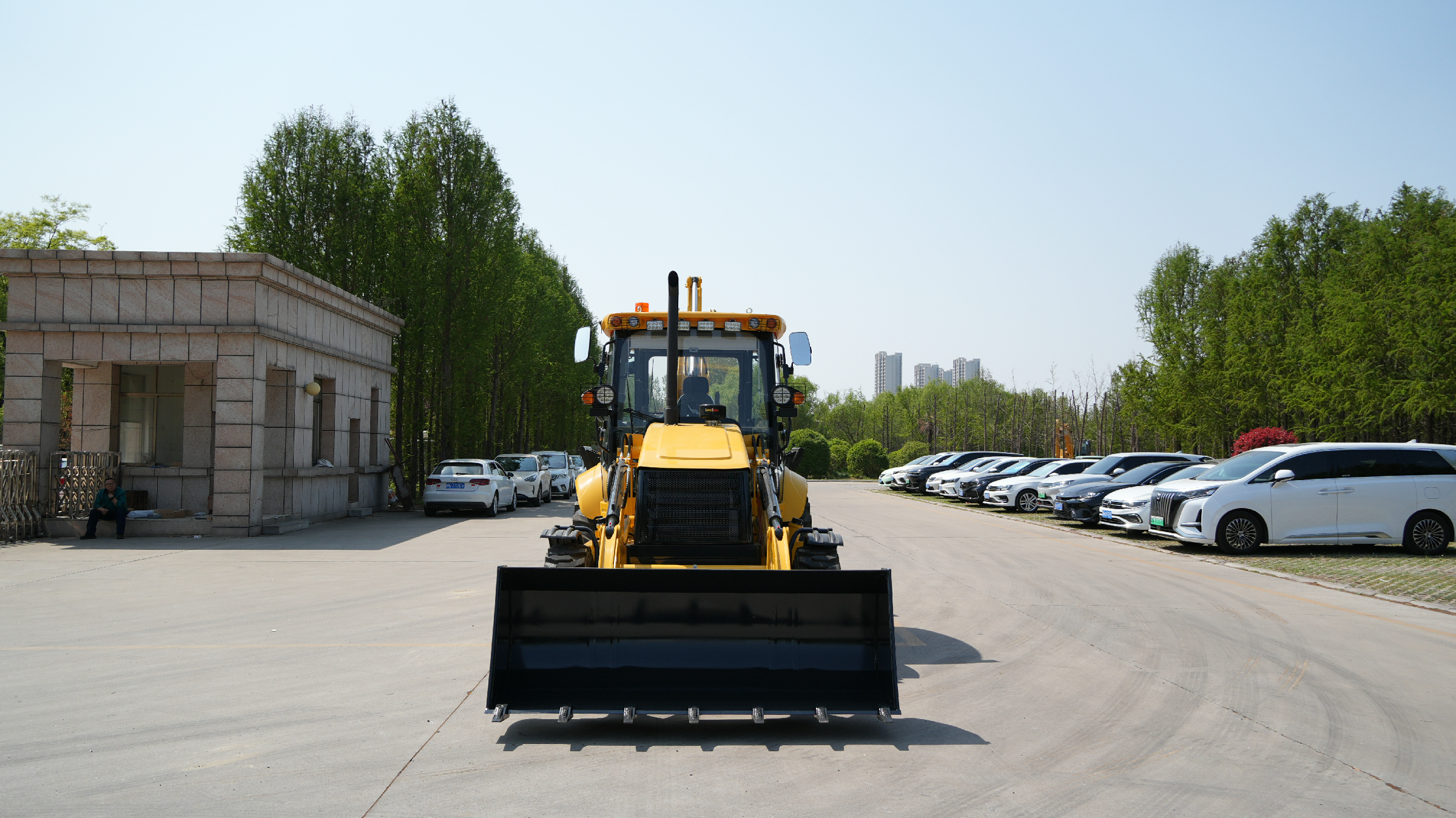
Agriculture is one of the applications where 4WD deserves serious consideration.
Farm environments can involve grass, soil, mud, slopes, gravel tracks, and unpaved access roads within the same property.
Backhoe loaders may be used for irrigation trenching, drainage maintenance, farm-road repair, material handling, and infrastructure construction.
The machine may therefore spend considerably more time away from firm paved surfaces.
In these conditions, improved traction can increase the number of places the machine can work effectively.
This is particularly valuable for agricultural contractors who move between different properties and cannot control the ground conditions at every site.
Four-wheel drive can improve traction on gradients, but slope operation needs to be considered much more carefully than simply choosing a drive configuration.
Machine stability, surface condition, slope angle, load position, travel direction, tire condition, and manufacturer operating limits all matter.
A loaded front bucket also changes the machine's behavior.
Contractors should never treat 4WD as a substitute for safe operating practices on slopes.
If a project regularly involves steep or difficult terrain, the complete machine configuration and operating environment should be discussed with the manufacturer.
The correct question is not simply "Can the machine climb the slope?"
It is whether the machine can perform the required work safely and productively under those conditions.
Very important.
Four-wheel drive cannot compensate for unsuitable or badly worn tires.
The tire is the component actually transferring driving force to the ground.
Tread pattern, condition, inflation, construction, and suitability for the working surface all influence traction.
A backhoe loader working primarily on paved urban surfaces may have different tire priorities from a machine operating on agricultural land or rough construction sites.
Buyers should therefore consider drive configuration and tire selection together.
Specifying 4WD while paying no attention to the tires misses part of the traction equation.
It can be useful during certain stages.
A finished road provides a relatively predictable surface, but road construction takes place long before the pavement is complete.
Backhoe loaders may work on exposed subgrade, gravel, embankments, roadside drainage areas, and temporary access routes.
These surfaces can become difficult after rain or repeated heavy-equipment traffic.
The machine may also need to move between excavation and loading tasks throughout the day.
For road-maintenance contractors working mainly on paved surfaces, the traction requirement may be lower.
For contractors regularly operating on unfinished roads, 4WD can provide more useful flexibility.
Not always.
Utility projects vary enormously.
A backhoe loader working on an established urban street may spend most of its time on pavement or compacted surfaces.
Another machine installing drainage or pipelines on a new development may operate almost entirely on unfinished ground.
Both are utility projects, but their traction requirements are different.
This is why equipment should be specified around the environment rather than the industry label.
If utility work regularly takes the machine onto loose, wet, or uneven ground, 4WD becomes more relevant.
If most work occurs on firm urban surfaces, other features may deserve higher priority.
Drive configuration can influence mechanical load and energy use, but actual fuel consumption depends on the machine design, working conditions, operator behavior, load, travel, hydraulic work, and how the drive system is used.
It is therefore misleading to judge a backhoe loader's operating cost from 2WD versus 4WD alone.
A machine struggling for traction can also waste energy through wheel spin and inefficient movement.
The more useful question is whether the selected drive configuration allows the machine to complete its normal work efficiently.
Equipment efficiency should always be evaluated against productive output rather than one isolated feature.
Two-wheel drive can still be perfectly practical where working conditions are predictable.
If the machine primarily operates on firm, level surfaces and does not regularly push into difficult material or travel through poor ground conditions, additional traction may not be a major requirement.
This can apply to certain municipal, yard, industrial, and paved-site applications.
The purchasing decision should reflect how frequently difficult traction conditions actually occur.
If they happen only rarely, buyers should weigh that against other configuration priorities.
If poor ground is part of normal daily work, the argument for 4WD becomes much stronger.
This is another useful distinction.
A 4WD backhoe loader and a tracked Excavator are fundamentally different machines.
The backhoe loader provides front loading, rear excavation, and wheeled mobility in one platform.
A tracked excavator is optimized more heavily around excavation and can provide different ground-contact characteristics.
If the contractor's primary requirement is continuous excavation on difficult terrain, a tracked excavator may be the more appropriate machine.
If the project needs excavation, loading, road travel, material movement, and frequent repositioning, the backhoe loader may provide greater versatility.
Four-wheel drive improves the wheeled machine's traction; it does not turn it into a tracked excavator.
Drive configuration should never become the only purchasing criterion.
For a backhoe loader, buyers also need to consider the rear digging system, front loader capacity, hydraulic performance, operating weight, transmission, axles, steering, tires, operator environment, maintenance access, and attachment requirements.
The balance between these systems determines how useful the machine will be.
A contractor who needs deep trenching should pay close attention to backhoe geometry.
A customer handling significant amounts of material should evaluate loader performance.
A buyer moving frequently between work areas should consider mobility and transmission characteristics.
Four-wheel drive is one part of the machine, not the entire specification.
Instead of simply requesting "a 4WD backhoe loader," describe the work.
Tell the supplier whether the machine will operate on construction sites, agricultural land, roads, municipal projects, or utility work.
Explain whether the ground is normally paved, compacted, muddy, sandy, gravelly, or uneven.
Describe the expected loader work and excavation requirements.
Mention slopes if they are a regular part of the operating environment.
Also provide the expected daily working hours and attachment requirements.
This information allows the manufacturer to look at the complete configuration rather than treating four-wheel drive as an isolated option.
MAXPOWER's Backhoe Loaders are positioned for applications requiring excavation and loading capability in one machine.
This makes the product category relevant to contractors working across construction, utilities, municipal projects, agriculture, and general infrastructure.
For customers whose work is primarily excavation-focused, MAXPOWER's Excavators provide another equipment direction.
The distinction is important.
A backhoe loader makes sense when the customer can make productive use of both ends of the machine and values wheeled mobility.
An excavator is generally more appropriate when digging represents the dominant workload.
MAXPOWER buyers should therefore start with their operating pattern before deciding which product category and configuration fits the business.
The answer becomes clearer when you look at the machine's expected working year rather than one project.
If the backhoe loader regularly encounters muddy sites, loose ground, agricultural land, unfinished roads, slopes, or loader work that demands traction, 4WD can provide useful capability.
If the machine spends almost all of its time on firm surfaces, the value may be less significant.
For equipment distributors, local customer conditions should also influence stock decisions.
A market dominated by agricultural and rural construction customers may have different expectations from a market focused on paved municipal maintenance.
The best configuration is the one customers can actually use.
A 4WD backhoe loader is not automatically the correct choice simply because four driven wheels sound more capable.
Its real advantage appears when traction limits productivity.
Soft soil, mud, loose construction surfaces, agricultural land, unfinished roads, gradients, and demanding loader work can all make four-wheel drive more valuable.
On firm, predictable surfaces, other specifications may matter more.
For buyers considering MAXPOWER Backhoe Loaders, the best approach is to evaluate excavation requirements, loader work, terrain, mobility, tires, hydraulic performance, and drive configuration as one complete system.
Choose 4WD because the work requires it—not because it is another box on the specification sheet.
It means the machine can deliver driving force through all four wheels according to the design of its drivetrain, providing additional traction when working or travelling on suitable surfaces.
Not directly. Rear excavation performance depends more on the hydraulic system, digging geometry, bucket, and machine stability. 4WD primarily improves traction and mobility.
It can provide better traction than two-wheel drive, but extremely soft ground can still immobilize a wheeled machine. Site conditions remain important.
It can be particularly useful for agricultural applications involving soil, mud, gravel tracks, slopes, irrigation projects, drainage, and farm-road maintenance.
Yes. Tire condition, tread and suitability for the surface directly affect how effectively driving force is transferred to the ground.
They serve different purposes. A backhoe loader combines excavation, loading and wheeled mobility, while a tracked excavator is more specialized for excavation work.
It may be sufficient where the machine mainly operates on firm, level surfaces and rarely encounters traction problems.
Consider the digging requirements, front-loader workload, terrain, drive configuration, tires, hydraulic performance, transmission, mobility, attachments, maintenance, and expected operating hours.







