Maxpower Construction Machinery Manufacturer




Mini excavators and small excavators are both compact construction machines, but they are not designed for exactly the same type of work.
A mini excavator is generally selected when access, maneuverability, low ground impact, and easy transportation are the main priorities. A small excavator offers greater digging force, lifting capacity, working range, and productivity while remaining more compact than a medium or large excavator.
The choice between a mini excavator and a small excavator should not be based on machine size alone. Contractors and equipment buyers also need to consider digging depth, material volume, attachment requirements, transportation conditions, ground stability, and expected daily workload.
This guide compares mini excavators and small excavators to help you determine which machine is better suited to your project.
A mini excavator is a compact tracked machine designed for work where larger equipment may be difficult to operate.
Mini excavators are frequently used in:
Landscaping
Residential construction
Utility installation
Drainage work
Agricultural projects
Indoor demolition
Small foundation projects
Narrow urban jobsites
Their smaller dimensions allow them to pass through restricted entrances and work near buildings, walls, fences, trees, pipelines and other obstacles.
For example, the MAXPOWER ME18U mini excavator has an operating weight of approximately 1.86 tons. Its adjustable undercarriage and compact structure are designed to support work in narrow spaces.
Mini excavators can also use different attachments, depending on the machine’s hydraulic system and configuration. These may include buckets, breakers, augers, grapples and other compact tools.
The most obvious advantage is the ability to work in limited spaces. This makes a mini excavator practical for residential areas, gardens, indoor projects and urban utility work.
A lighter machine is generally easier to move between jobsites. This can be especially valuable for contractors who complete several small projects in different locations.
Actual transportation requirements still depend on the machine, trailer, towing vehicle and local regulations.
Mini excavators usually exert less overall pressure on finished surfaces than heavier equipment. They can be useful where contractors need to reduce damage to lawns, pavements or landscaped areas.
Compact dimensions and responsive controls can support accurate work around walls, utility lines and existing buildings.
Although a mini excavator has lower attachment capacity than a larger machine, it can still handle many common tools for trenching, drilling, breaking and material handling.
A mini excavator may not provide sufficient performance for:
Deep excavation
Heavy lifting
High-volume earthmoving
Large foundation work
Heavy rock breaking
Continuous demanding production
Using an undersized machine for a large project can increase working hours and reduce overall productivity.
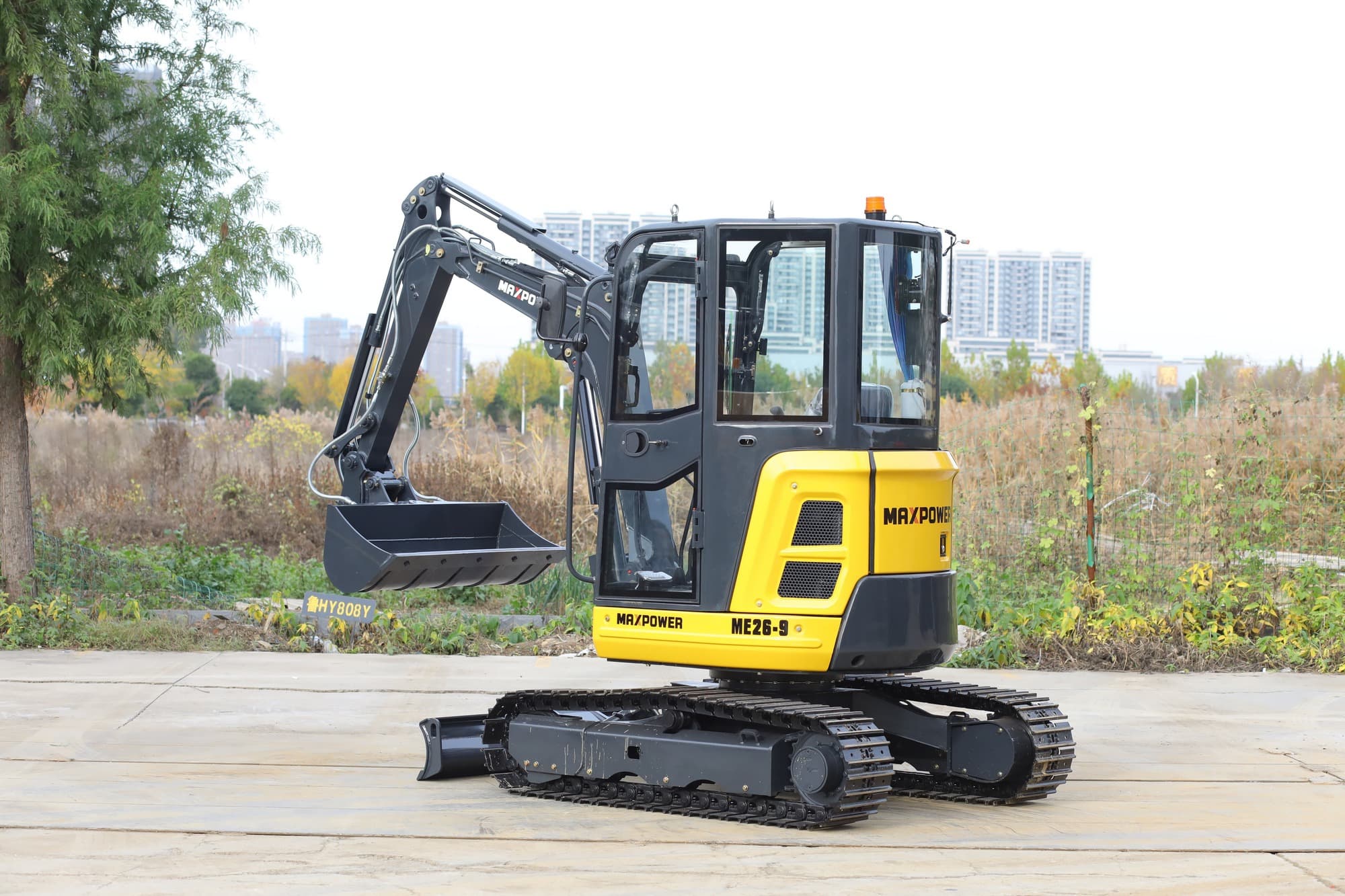
A small excavator is larger and more capable than most mini excavators but remains more maneuverable than a medium excavator.
It is often used for:
Commercial construction
Municipal engineering
Roadside excavation
Drainage installation
Foundation preparation
Pipeline work
Site development
General earthmoving
Small excavators provide a practical middle ground for buyers who need more capacity than a mini excavator but do not require a medium or large machine.
The MAXPOWER ME130 small excavator, for example, has an operating weight of 13 tons and a 0.53 m³ bucket capacity. It is designed for work requiring greater digging and loading capacity than compact mini equipment.
MAXPOWER also offers smaller models within its broader excavator range, allowing buyers to compare machine weight, bucket capacity, power and working dimensions according to the application.
A small excavator normally provides more digging force, reach and depth than a mini excavator.
This makes it more appropriate for foundations, commercial trenching, drainage systems and general construction.
Greater machine weight and hydraulic capacity generally allow a small excavator to handle heavier pipes, materials and attachments.
However, actual lifting capacity depends on the lifting radius, machine position, boom configuration, ground conditions and manufacturer specifications.
A larger bucket can move more material during each cycle. This can significantly improve productivity on earthmoving and site preparation projects.
Small excavators are more suitable for longer operating cycles and more demanding materials where a mini excavator may work too slowly.
A small excavator can support a wider range of construction projects, making it attractive to contractors, distributors and equipment rental companies that require versatility.
A small excavator may involve:
Higher transportation costs
More restricted access
Greater ground impact
Higher fuel or energy consumption
More demanding transport equipment
Reduced flexibility on confined sites
These considerations do not make a small excavator less efficient. They simply mean the machine must be matched to the correct project.
Operating weight is one of the clearest differences.
Mini excavators occupy the lighter end of the range, while small excavators provide a step up in machine mass and capacity.
However, buyers should not depend only on category names. Different manufacturers may classify the same operating weight differently.
Always check:
Actual operating weight
Standard bucket
Cab or canopy configuration
Additional counterweight
Installed attachments
Track and blade configuration
These factors may affect both transport weight and machine performance.
Mini excavators are better suited to restricted jobsites.
They may be selected where the machine must pass through:
Narrow gates
Residential entrances
Alleys
Indoor access points
Areas between buildings
Landscaped spaces
A small excavator requires more working room, particularly for upper-structure rotation and counterweight clearance.
Before ordering a machine, measure the narrowest access point rather than relying only on general jobsite dimensions.
Small excavators generally offer greater digging depth and working reach.
This difference matters for:
Utility trenches
Drainage systems
Foundations
Pipeline installation
Loading trucks
Excavating below existing grades
A mini excavator may be sufficient for shallow trenches and light residential work. A small excavator is usually more suitable when deeper excavation or greater horizontal reach is required.
The machine should have a reasonable performance margin rather than operating at its maximum reach throughout the project.
For a broader sizing process, read our guide to choosing the right excavator size.
A small excavator normally has a larger hydraulic system, heavier structure and greater digging capability.
This can improve productivity when handling:
Compacted soil
Clay
Gravel
Construction debris
Broken concrete
Larger excavation volumes
A mini excavator can still perform many of these tasks on a small scale, but production rates may be lower.
The correct comparison is not simply whether a machine can perform the task. Buyers should also consider how quickly and efficiently it can complete the required workload.
Small excavators normally have an advantage when lifting heavier materials.
Greater machine weight can improve stability, while stronger hydraulic and structural systems support more demanding lifting work.
Excavators may be used to position:
Drainage pipe
Concrete components
Utility structures
Steel materials
Attachments
Construction supplies
Lifting performance changes according to reach and position. Loads lifted close to the machine are different from loads handled at maximum horizontal reach.
Always use the lifting information provided for the specific machine and configuration. Do not estimate safe capacity based only on operating weight.
Both machine classes can support multiple attachments, but a small excavator can generally operate larger tools.
Mini excavator attachments may include:
Narrow trenching buckets
Grading buckets
Small hydraulic breakers
Augers
Grapples
Rippers
Small excavator attachments may include:
Larger buckets
Heavier breakers
Compaction plates
Larger augers
Hydraulic grapples
Specialized demolition tools
Attachment compatibility depends on hydraulic flow, pressure, machine stability, carrier weight and mounting specifications.
The attachment plan should be discussed before the machine is purchased.
Mini excavators are generally easier to transport, making them useful for contractors who relocate equipment frequently.
A small excavator may require:
A larger trailer
A heavier transport vehicle
Additional loading arrangements
Route planning
Permits in some regions
Transportation requirements vary by country and machine configuration. Buyers should confirm local axle, weight and dimensional limits.
A machine that is highly productive on site may still be unsuitable if it cannot be moved efficiently between projects.
Mini excavators generally have lower initial and transport costs than small excavators, but purchase price should not be the only consideration.
A smaller machine can become less economical when:
Excavation volumes are high
Materials are heavy
The machine operates near maximum capacity
Project deadlines are tight
Larger attachments are required
A small excavator may cost more initially but complete demanding work in fewer hours.
The correct decision should consider cost per completed task rather than equipment price alone.
A mini excavator is usually the more practical choice.
Its compact size helps operators work around trees, walls, fences and completed surfaces. It can perform tasks such as planting preparation, drainage excavation, small grading work and removal of light materials.
Mini excavators are suitable for many residential applications, including:
Small foundations
Drainage
Utility trenches
Pool preparation
Site cleanup
A small excavator may be better when the project involves larger foundations, higher material volumes or heavier lifting.
Both machine classes can be suitable.
Choose a mini excavator when access is limited and trench requirements are moderate. Choose a small excavator when the project requires deeper trenches, larger pipe handling or faster production.
Excavation work can expose operators and workers to cave-ins, underground utilities and other hazards. Contractors should consult applicable safety requirements, including the U.S. Occupational Safety and Health Administration’s trenching and excavation guidance.
A small excavator is normally more suitable for commercial jobs requiring greater capacity and continuous operation.
It may be used for foundations, drainage, earthmoving, material handling and site development.
Mini excavators can still support specialized work in narrow areas within the same project.
A small excavator often provides a stronger combination of digging power, reach and productivity for road and municipal projects.
Mini excavators can be valuable for localized repairs, pavement-side utility access and confined urban work.
A mini excavator may be sufficient for:
Irrigation trenches
Fence post preparation
Drainage
Landscaping
Light land improvement
A small excavator may be more appropriate for larger drainage systems, pond excavation, road maintenance and heavier land-clearing work.
Mini excavators can support controlled interior or small-scale demolition when the building structure and access conditions allow.
Small excavators are more suitable for heavier materials and higher-capacity attachments.
Machine selection should account for the structure, working surface, attachment weight, falling material and site safety plan.
Choose a mini excavator when:
Access is highly restricted
Projects are mainly residential or landscaping-related
Transportation flexibility is important
Ground disturbance needs to be limited
Digging and lifting requirements are moderate
The machine will frequently move between small jobsites
Choose a small excavator when:
Greater digging force is required
Excavation volumes are higher
Deeper digging and longer reach are needed
Heavier attachments will be used
The machine must lift larger materials
Projects include commercial, municipal or road construction
In some fleets, both machine classes are valuable. A mini excavator can complete precision work in confined areas, while a small excavator handles higher-production excavation.
Before requesting a quotation, prepare answers to the following questions.
Identify the expected soil, clay, gravel, rock, concrete or mixed material.
Provide the normal digging depth and the maximum required depth.
Estimate the daily or total excavation volume.
Include the heaviest expected pipe, attachment or construction component.
Measure gates, roads, alleys and other restricted access points.
Specify buckets, breakers, augers, grapples or other tools.
Frequent relocation may increase the importance of compact dimensions and lower transport weight.
Soft soil, finished pavement, slopes and uneven terrain may affect the preferred operating weight and undercarriage.
Two excavators with a similar operating weight may still differ in:
Engine power
Hydraulic flow
Digging force
Boom and arm dimensions
Bucket capacity
Tail-swing design
Undercarriage width
Attachment compatibility
Operator environment
That is why buyers should compare full specifications rather than selecting a machine only because it is described as “mini” or “small.”
You can review the full MAXPOWER excavator range to compare models for different construction applications.
International buyers, contractors and equipment distributors often need more than a standard machine.
Their requirements may include:
Engine options
Attachment packages
OEM branding
Cab or canopy configurations
Climate-specific equipment
Spare parts support
Technical documentation
Service guidance
MAXPOWER develops and manufactures excavators ranging from compact mini machines to larger construction and mining equipment.
By sharing project conditions, digging requirements, destination market and attachment needs, buyers can receive a recommendation based on the intended application rather than selecting from operating weight alone.
There is no universal winner in the mini excavator vs small excavator comparison.
A mini excavator is the better choice when maneuverability, transportation and confined-space performance are the main priorities.
A small excavator is the better choice when the project requires greater digging force, lifting capacity, working range and daily productivity.
Before choosing, compare:
Operating weight
Machine dimensions
Digging depth
Working reach
Bucket capacity
Hydraulic performance
Attachment requirements
Transportation conditions
Expected workload
The best machine is the one that can complete the intended work efficiently without being unnecessarily large or underpowered.
Contact MAXPOWER with your project requirements or explore our excavator models to identify a suitable machine configuration.
Not always. The terms may overlap between manufacturers, but mini excavators generally prioritize compact access and low operating weight, while small excavators provide greater digging and lifting capacity.
Mini excavators are commonly used for landscaping, residential construction, utility trenches, drainage, agriculture and confined urban projects.
Small excavators are suitable for commercial construction, foundations, roadwork, municipal engineering, drainage, pipelines and general earthmoving.
A mini excavator may handle small residential foundation work when the required depth, soil conditions and material volume are within its capacity. Larger foundations may require a small or medium excavator.
It normally requires more transport capacity than a mini excavator. The exact requirements depend on machine weight, dimensions, trailer capacity and local regulations.
A mini excavator may be more economical for small and confined projects. A small excavator may provide a lower cost per completed task when excavation volumes and performance requirements are higher.
Yes, provided the breaker matches the machine’s carrier weight, hydraulic pressure, flow and mounting specifications.
Send the application, material type, digging depth, lifting requirements, attachments, working environment, transportation limits, expected operating hours and destination country.







