Maxpower Construction Machinery Manufacturer




Choosing an excavator is often treated as a simple question of machine size: small excavator for small jobs, large excavator for large jobs.
In practice, that approach can lead to the wrong equipment.
A contractor may have enough excavation capacity but still lose productivity because the machine is too wide for the site, difficult to transport, poorly matched to the soil, or unnecessarily large for the work being performed. The opposite can happen as well: a compact machine may be easy to move around but lack the digging depth, hydraulic performance, or stability required for the project.
The better approach is to start with the jobsite and work backward toward the machine.
This guide explains how contractors, equipment distributors, and project managers can choose an excavator for different construction sites, with particular attention to site access, excavation requirements, working conditions, and overall equipment utilization.
The current MAXPOWER excavator range covers mini, small, medium, and large excavators, giving buyers several machine classes to consider for different applications.
Two construction projects can require completely different excavators even when both involve digging.
Consider a utility contractor working beside an existing road. The excavation may not be particularly deep, but the machine has to work within a narrow space while avoiding underground infrastructure and maintaining access for traffic.
Now consider a quarry contractor. The priority is completely different. Digging force, machine stability, bucket capacity, hydraulic performance, and durability become much more important than compact dimensions.
A machine that performs well in one situation may be inefficient in the other.
This is why excavator selection should begin with questions about the work rather than questions about horsepower.
Before looking at models, identify the conditions in which the excavator will actually operate.
How much room is available?
How deep does the machine need to dig?
What material will it handle?
How far does it need to reach?
Will it work eight hours a day or only occasionally?
How often will it move between sites?
Will it operate on hard ground, soft soil, slopes, or uneven terrain?
These questions have a direct influence on machine selection.
A contractor who understands these conditions can usually narrow the equipment choice much faster than someone who starts by comparing dozens of specifications.
Mini excavators make sense when access is the main problem.
Residential construction, landscaping, drainage installation, small utility projects, and property maintenance often take place in areas where a conventional excavator simply cannot move comfortably.
The machine may need to pass through a narrow gate, work beside an existing building, or operate in a confined backyard.
In these situations, additional digging capacity does not necessarily improve productivity. If the machine cannot position itself properly, its theoretical performance becomes irrelevant.
A compact excavator can also reduce the disruption caused by construction work in populated areas.
For contractors handling a large number of smaller projects, that flexibility can be more valuable than having a much larger machine.
There is a point where a mini excavator becomes too limited for the workload.
Small excavators provide more digging and lifting capability while remaining relatively manageable for transportation and restricted jobsites.
They can be a better fit for contractors handling a mixture of utility work, residential construction, drainage, road maintenance, and general excavation.
The decision often comes down to workload rather than project size alone.
If the machine will spend most of its time digging shallow trenches, a compact machine may be sufficient. If the same contractor regularly needs greater reach, deeper excavation, or larger buckets, stepping up to a small excavator can prevent productivity from being constrained by machine capacity.
Medium excavators are often where general construction requirements begin to change significantly.
They provide considerably more excavation capability while remaining practical for a broad range of construction and infrastructure projects.
A good example is a contractor working on commercial foundations or larger utility projects.
The machine may need to excavate for longer periods, handle larger quantities of material, and work at greater depths than a compact excavator can comfortably manage.
MAXPOWER's current range includes medium excavator models such as the ME210, which has an operating weight of 21.8 tonnes and a 1 m³ bucket capacity. The manufacturer lists the model for applications requiring stronger excavation and working performance.
The important point is not the number itself. It is whether the machine's operating weight, bucket size, digging capability, and hydraulic system correspond to the workload.
Large excavators should be selected when the project can actually use their capacity.
Heavy earthmoving, quarrying, major infrastructure construction, deep excavation, and high-volume material handling can justify a larger machine.
The mistake is purchasing a large excavator simply because it appears more productive.
A larger machine usually brings higher transportation requirements and may require more space to operate. If the jobsite cannot take advantage of its additional capacity, the contractor may be paying for capability that remains unused.
For heavy applications, however, the difference can be substantial.
For example, MAXPOWER's ME390 large excavator has an operating weight of 37.5 tonnes and a 1.8 m³ bucket. Its manufacturer describes the model as being designed for heavy excavation and demanding material-handling work.
For a contractor moving large volumes of hard material, that additional capacity can directly affect daily production.
Limited access is one of the easiest factors to overlook during equipment purchasing.
A machine may have excellent digging specifications but still be unsuitable if it cannot physically reach the working area.
Measure the entrance before ordering.
Check the available width, height, turning space, ground conditions, and transport route.
This is especially important for:
Urban construction
Residential projects
Indoor work
Utility installation
Renovation projects
For restricted jobsites, overall machine dimensions can be just as important as operating weight or engine power.
Ground conditions can change the equipment requirement considerably.
Soft soil may not demand the same digging force as compacted clay, gravel, or rock.
Hard materials place greater demands on the bucket, hydraulic system, boom, arm, and overall machine structure.
This is where simply choosing an excavator according to operating weight becomes unreliable.
A machine should be evaluated according to the actual material it will excavate.
If the project involves hard or abrasive material, buyers should pay particular attention to digging force, hydraulic performance, bucket configuration, undercarriage durability, and the suitability of the machine for continuous heavy work.
Not necessarily.
Digging depth is only one part of the equation.
The machine also needs enough reach to work efficiently at the required distance. In some projects, lifting and dumping height can be just as important as maximum digging depth.
For example, a contractor excavating a foundation may need to reach deep into the excavation while maintaining a stable working position.
A contractor loading material into trucks may care more about reach and dumping height.
This is why maximum digging depth should never be considered in isolation.
Hydraulic performance is one of the less visible but more important aspects of an excavator.
The hydraulic system controls much of the machine's working behavior, including boom, arm, bucket, and other hydraulic functions.
A machine that combines suitable hydraulic performance with the right working equipment can maintain smoother and more consistent cycles.
MAXPOWER's ME210, for example, is described by the manufacturer as using a hydraulic system designed for efficient operation, with the product page highlighting pump efficiency, operating speed, and reduced noise.
For buyers comparing machines from different manufacturers, it is worth looking beyond engine power and asking how the engine, hydraulic system, pump, and working equipment function together.
The operating environment should determine this decision.
Diesel excavators remain practical for remote sites, heavy earthmoving, and projects where continuous operation and conventional refueling infrastructure are important.
Electric excavators become more interesting when the project has strict requirements around emissions and noise.
Urban construction, indoor projects, residential areas, and environmentally sensitive locations can benefit from electric equipment.
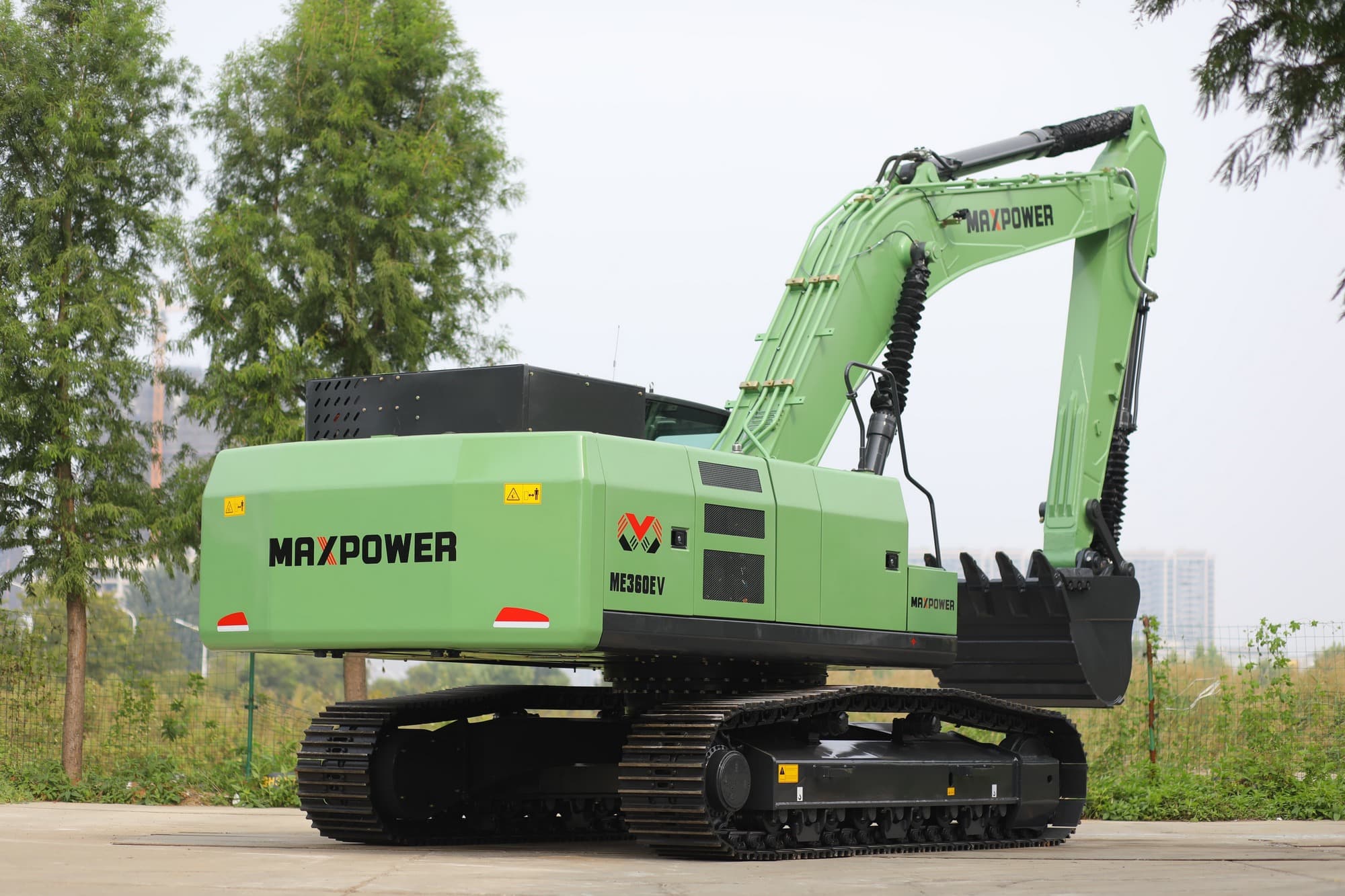
The current MAXPOWER electric excavator range includes machines from the ME18EV at 1.86 tonnes up to larger models such as the ME240EV and ME360EV.
This means the decision does not necessarily have to be based on the assumption that electric equipment is only suitable for very small jobs.
Instead, contractors should evaluate the required machine size, working hours, charging conditions, and site requirements together.
Transportation can become a hidden cost when selecting construction equipment.
A machine that performs exceptionally well on site may become less attractive if moving it between projects requires complicated logistics every time.
For contractors working on a single large project, this may not matter much.
For contractors moving equipment between multiple sites every week, it matters considerably.
Before purchasing, consider how the excavator will reach the jobsite, whether special transportation arrangements are required, and how frequently the machine will be moved.
A slightly smaller excavator that can be transported more easily may sometimes produce better overall business results than a larger machine with unused capacity.
The right attachment can change what an excavator is capable of doing.
But buyers should not select attachments simply because a manufacturer offers many options.
Start with the work.
A contractor specializing in utility trenching may prioritize different buckets from a demolition contractor. A landscaping company may have different requirements again.
Attachment selection should also be compatible with the excavator's hydraulic system and operating capacity.
The objective is to create a machine configuration that matches the actual workflow rather than building the most complicated equipment package possible.
Oversizing is a common equipment purchasing mistake.
A larger excavator can look attractive because its specifications appear stronger, but the additional capacity only creates value when the project can use it.
If most of the contractor's work consists of shallow utility trenches and small construction sites, a large excavator may spend much of its time operating below its potential.
That can mean unnecessary transportation costs, higher operating expenses, and less flexibility on restricted sites.
The better approach is to identify the most common workload rather than the most demanding job the company might encounter once a year.
The opposite mistake can be equally expensive.
A machine that is too small may need more cycles to complete the same excavation work. It can also struggle with hard material, large volumes, or deeper excavation.
If the excavator operates continuously at the edge of its capability, productivity can suffer.
A good equipment selection process therefore looks for the point where the machine has enough capacity to complete normal work efficiently without paying for capabilities that are rarely used.
Distributors face a different challenge from contractors.
A contractor usually knows what type of work the machine will perform. A distributor needs equipment that can satisfy several customer groups.
In this situation, a product range covering different excavator classes can be more useful than relying on a single machine size.
MAXPOWER currently organizes its excavator range into mini, small, medium, and large categories, alongside electric and specialty excavator solutions.
This gives distributors more flexibility when matching equipment to customer applications.
For international buyers, manufacturer support, spare parts, technical communication, and product documentation should also be evaluated before building a long-term equipment portfolio.
The most useful equipment supplier is not necessarily the one offering the largest machine or the longest specification sheet.
What matters is whether the manufacturer can provide equipment that matches different working conditions.
MAXPOWER's current product portfolio includes conventional excavators across different size classes, as well as electric excavators and specialty excavators.
For contractors, this makes it possible to approach equipment selection according to the application rather than forcing every project into the same machine category.
You can explore the full Excavator range, or compare it with Electric Excavators when emissions and noise are important considerations.
For projects requiring a different machine configuration, Specialty Excavators and Backhoe Loaders are also available.
The most reliable equipment selection process starts with the work itself.
If the site is restricted, prioritize dimensions and maneuverability.
If excavation is deep, look closely at reach and digging capability.
If the material is hard, pay attention to hydraulic performance, digging force, and machine durability.
If the machine moves frequently between sites, transportation becomes a major consideration.
If the project is located in a noise- or emission-sensitive environment, electric equipment may deserve closer evaluation.
And if the workload changes from project to project, versatility may be more valuable than maximum capacity.
There is no single excavator that is ideal for every construction site. The right machine is the one that matches the work your business performs most often.
Choosing an excavator should not begin with the question, "Which model has the highest specifications?"
It should begin with a much more practical question:
What does this machine need to do every working day?
Once the jobsite, material, excavation depth, access conditions, transportation requirements, operating hours, and working environment are understood, the appropriate excavator class becomes much easier to identify.
Mini excavators can solve access problems. Small and medium excavators provide a balance between mobility and excavation performance. Large excavators make sense when projects require high-volume or heavy-duty earthmoving. Electric excavators provide another option where noise and emissions are important.
For contractors and equipment buyers, matching the machine to the workload is ultimately more valuable than simply choosing the biggest machine available.
Start with the required digging depth, reach, material type, jobsite access, expected workload, and transportation requirements. The machine should have enough capacity for normal operations without being unnecessarily oversized.
Yes. Mini excavators are well suited to restricted-access construction, landscaping, utility work, drainage, residential projects, and other applications where maneuverability is important.
A medium excavator is worth considering when projects require more digging capacity and longer working cycles than compact machines can provide, particularly for commercial construction, infrastructure, and larger utility projects.
Large excavators are generally justified when the project involves high-volume excavation, heavy materials, deep excavation, quarrying, or major infrastructure work.
They can be particularly suitable for urban, indoor, residential, and environmentally sensitive projects where reduced direct emissions and lower noise are important. The availability of suitable charging infrastructure should also be considered.
No. If the jobsite is restricted or the workload does not require the additional capacity, a larger excavator may actually reduce overall efficiency because of transportation, access, and operating requirements.







