Maxpower Construction Machinery Manufacturer




Bored pile construction can become expensive very quickly when the drilling equipment does not match the ground conditions or foundation design.
A contractor may have enough nominal drilling depth but insufficient torque for the formation. Another machine may drill efficiently in clay but struggle when gravel or weathered rock appears. On a congested foundation site, poor positioning and slow spoil removal can create another bottleneck entirely.
These are not minor equipment issues. When piling work falls behind, subsequent reinforcement, concrete placement, pile-cap construction, and structural work may also be delayed.
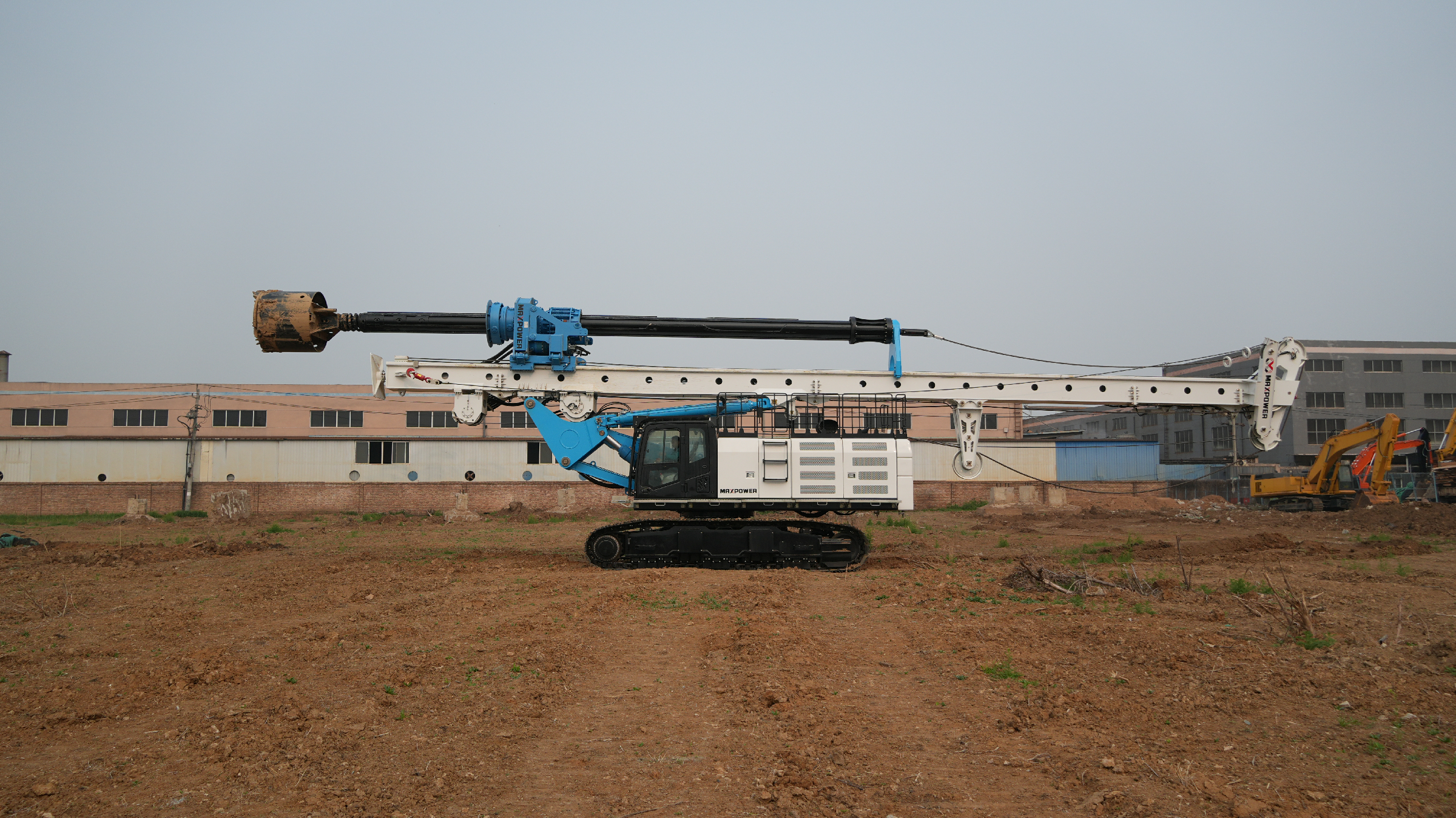
A rotary drilling rig for bored piles is designed around this type of foundation work. It combines rotary torque, crowd force, a Kelly bar system, drilling tools, hydraulic control, and a stable carrier to create pile holes under a range of geological conditions.
MAXPOWER's Rotary Drilling Rig product line is intended for foundation engineering applications where contractors need dedicated drilling equipment rather than adapting general construction machinery to specialist piling work.
The important question for a buyer, however, is not simply whether rotary drilling can make a hole. It is whether the rig can maintain the required diameter, depth, drilling efficiency, and stability under the actual conditions of the project.
Deep foundations are used when near-surface soil cannot provide sufficient support for the planned structure or when the foundation design requires loads to be transferred to deeper strata.
That creates a very different equipment requirement from ordinary excavation.
An excavator removes material from an open excavation. A rotary drilling rig has to create a relatively deep, controlled bore while keeping the drilling position aligned with the foundation layout.
The machine therefore needs to manage several tasks as one system: apply rotary torque to the drilling tool, control penetration, repeatedly remove spoil from the bore, maintain drilling alignment, and reach the design depth.
This is why a dedicated drilling rig becomes important for bored pile work. The project is not simply asking for more digging power. It requires controlled vertical drilling.
A typical drilling cycle begins after the rig has been positioned at the pile location and the mast has been aligned.
The rotary drive turns the Kelly bar and drilling tool. As the tool penetrates the formation, soil or fragmented material enters the drilling bucket or other suitable tool.
The tool is then lifted from the bore and emptied before the next cycle begins.
This process continues until the required depth is reached.
The finished bore can then move into the next foundation stages according to the engineering design and construction method, which may include cleaning, reinforcement placement and concrete work.
The drilling rig therefore sits at the beginning of a chain of operations. If drilling is inconsistent, everything behind it can be affected.
A machine does not drill "soil" in a generic sense.
A project may encounter clay near the surface, sand several metres below it, followed by gravel and weathered rock. Groundwater can introduce another layer of complexity.
Each formation behaves differently under the drilling tool.
Clay can adhere to tools and affect discharge. Loose sand may create bore stability concerns. Gravel can make penetration less predictable. Harder formations require greater attention to torque and tooling.
This is why choosing a rotary drilling rig from a specification sheet alone can be risky.
Before equipment selection, the contractor should understand the geotechnical information available for the project and discuss the expected formations with the equipment supplier.
The question should not be, "What is your biggest drilling rig?"
It should be, "What configuration suits this pile design and geology?"
Rotary torque is one of the headline specifications buyers naturally compare.
More torque can help a drilling tool work through resistant formations, but selecting the highest torque available is not automatically the best purchasing strategy.
The required torque depends on the pile diameter, drilling tool, ground resistance and drilling method.
A contractor working mainly in relatively manageable soils may not need the same machine as a foundation company regularly encountering dense gravel or weathered rock.
Overspecifying the rig can increase equipment size and logistical requirements without necessarily improving the economics of ordinary projects.
Underspecifying it creates the opposite problem: drilling slows dramatically whenever ground resistance increases.
The useful specification is therefore not maximum torque by itself. It is sufficient torque for the formation the machine is expected to encounter most often.
Depth and diameter should be considered together.
A deeper pile requires sufficient Kelly bar capability and drilling system performance. A larger diameter increases the volume of material removed and can place greater demands on the rotary drive and drilling tool.
A rig that can reach the required depth on paper may still be poorly matched if the intended pile diameter and ground conditions demand more from the machine than the specification comfortably supports.
This matters particularly for contractors bidding on different types of foundation projects.
If the rig will be expected to handle a range of pile designs, the buyer needs to define the practical operating envelope they expect from the machine rather than focusing only on the largest theoretical depth.
When drilling slows down, buyers sometimes assume the machine needs more power.
Often, the cause is elsewhere.
The drilling tool may not suit the formation. Spoil may not discharge efficiently. The operator may be using an unsuitable penetration strategy. The rig may spend too much time repositioning between pile locations.
Site logistics can also restrict production.
If spoil is not removed from the drilling area quickly enough, the rig may have to wait. If reinforcement and concrete operations are poorly coordinated with drilling, the overall piling sequence can become inefficient even though the rig itself is performing well.
This is why drilling productivity should be measured across the complete cycle rather than simply by how quickly the tool rotates.
Tool selection needs to follow the geology.
A drilling bucket suitable for one formation may not be the most efficient choice in another. Different ground conditions can require different bucket, auger or rock-drilling configurations.
This is an area where project information becomes especially valuable.
Providing the manufacturer with borehole logs or a clear description of the expected formations can lead to a much more useful equipment discussion than requesting a rig and selecting tooling afterward.
The rig and drilling tool should be treated as one working system.
A high-performance rotary drive cannot deliver its full potential through a tool poorly suited to the ground.
Groundwater can make bored pile construction considerably more complicated.
The issue is not simply that the bore becomes wet. Unstable formations can create risks to bore integrity, particularly where loose soils and groundwater occur together.
Depending on the foundation design and construction method, temporary casing or other bore-support techniques may be required.
These decisions belong to the project's geotechnical and foundation engineering process rather than the drilling rig alone.
For equipment buyers, the important point is that groundwater conditions should be identified before selecting the machine and drilling method.
A supplier should understand the site conditions rather than recommending equipment from pile depth alone.
A rotary drilling rig works with a tall mast and substantial drilling loads. Stable positioning is therefore fundamental to accurate and controlled operation.
Ground bearing conditions at the drilling platform need attention before work begins.
An inadequately prepared platform can affect machine positioning and create serious operating risks.
Contractors should evaluate site access and working-platform requirements during project planning rather than waiting until the rig arrives.
The largest machine is not useful if the site cannot safely accommodate its dimensions, weight and operating requirements.
Usually not efficiently.
Foundation contractors encounter different pile diameters, depths, formations and project layouts.
A rig selected for relatively small bored piles may not provide the required performance for much larger foundation work. A large machine designed for demanding projects may be unnecessarily cumbersome on smaller sites.
The better purchasing approach is to look at the company's actual project pipeline.
What pile diameters appear most often?
What depths are typical?
Which geological conditions occur repeatedly?
How frequently does the machine move between projects?
Those questions reveal far more about the appropriate rig than choosing equipment according to the largest project the company might theoretically win.
These machines solve different problems.
An Excavator is the more appropriate machine when the work involves open excavation, trenching, bulk earthmoving or material handling.
A rotary drilling rig becomes relevant when the foundation design requires bored piles or similar drilled foundation work.
On a major foundation project, both machines may be present.
The drilling rig creates the pile bores, while excavators can support site preparation, spoil handling and other earthmoving operations.
Treating them as competing machines misses the point. They perform different roles within the construction process.
A useful purchasing discussion should begin with project data.
Provide the expected pile diameter and depth, geological conditions, groundwater information where available, daily production expectations, site access restrictions and transportation requirements.
The supplier also needs to understand whether the rig will stay on one large project for an extended period or move frequently between smaller sites.
That difference can influence the practical value of machine dimensions and transport requirements.
Buyers should also discuss tooling, maintenance, wear parts, technical documentation and after-sales support.
Foundation drilling equipment works under demanding loads. Long-term productivity depends on more than the machine's initial specification.
When a general-purpose machine stops, a contractor may sometimes be able to move another unit onto the job.
Foundation drilling equipment is more specialized.
If the rotary drilling rig is the only machine on site capable of creating the required pile bore, downtime can interrupt the entire foundation sequence.
Spare-parts planning and technical support therefore deserve attention before purchase.
Buyers should understand how routine wear components are supplied, what maintenance documentation is provided and how technical problems are communicated to the manufacturer.
For international customers, these questions are particularly important because the machine may operate far from the manufacturing facility.
MAXPOWER's product portfolio is broader than general excavation machinery.
Its Rotary Drilling Rig category gives foundation contractors and equipment buyers a dedicated product direction for drilling applications.
The company's Excavators can complement foundation projects where site preparation, earthmoving and material handling are also required.
For projects with unusual excavation requirements, MAXPOWER also maintains a Specialty Excavators category.
This makes it possible to approach equipment selection according to the actual construction process instead of trying to use one machine category for every stage.
For a bored pile project, the rotary drilling rig should be selected around the pile design and geology. Supporting excavation equipment can then be selected around the remaining site work.
The biggest gains often come from matching the entire drilling process rather than simply increasing machine power.
The rig needs to suit the pile design.
The tool needs to suit the formation.
The operator needs to understand how the ground responds.
Spoil removal needs to keep pace with drilling.
The working platform needs to allow efficient repositioning.
Maintenance needs to be planned around production rather than waiting for a failure.
When these elements are coordinated, the rotary drilling rig can spend more of the working day actually drilling.
That is a more useful measure of productivity than any single specification on the machine.
A rotary drilling rig solves a very specific construction problem: creating controlled deep foundation bores efficiently under real geological conditions.
For bored pile contractors, selecting the right machine starts with pile diameter, drilling depth and geology. Rotary torque, Kelly bar configuration, drilling tools, machine stability and site logistics then need to be considered as parts of the same system.
Choosing a rig simply because it has the highest specification can be just as inefficient as selecting one that is too small.
MAXPOWER provides Rotary Drilling Rig solutions alongside its broader excavation equipment range, allowing contractors to match machinery to different stages of foundation and infrastructure construction.
Before ordering a rig, define the pile and the ground first. The machine selection becomes much clearer after that.
A rotary drilling rig is commonly used to create bored pile holes and other drilled foundations for buildings, bridges and infrastructure projects.
It provides a dedicated system for controlled vertical drilling, combining rotary torque, drilling tools, a Kelly bar and hydraulic functions for deep foundation work.
Start with pile diameter, required depth, geological conditions, groundwater conditions, production requirements and site access. Then match the rig and drilling tools to those conditions.
No. The required torque depends on pile size, formation and tooling. Excess capacity can add equipment and transport requirements without improving ordinary drilling work.
Suitable rotary drilling rigs can work in harder formations when correctly configured with appropriate drilling tools. The actual geology should be evaluated before equipment selection.
Ground conditions, drilling tool selection, rotary performance, spoil removal, operator technique, site logistics and maintenance can all affect the drilling cycle.
A conventional excavator is designed primarily for open excavation and material handling. Bored pile construction normally requires dedicated foundation drilling equipment appropriate to the pile design and construction method.
Provide pile diameter, drilling depth, geotechnical information, expected ground conditions, groundwater information where available, project location, site restrictions and expected production requirements.







