Maxpower Construction Machinery Manufacturer




A narrow gate can decide an equipment purchase before digging performance enters the conversation. For a contractor working behind an existing building, the first question is practical: can the machine reach the excavation without removing fences or changing the access route?
Mini excavator width is the starting point—not the complete answer.
The MAXPOWER ME18EV electric excavator has published dimensional specifications that buyers can use to assess restricted access. Here is how to turn those figures into a useful site assessment rather than buying from a model name alone.
The ME18EV product page lists overall width as 950/1280 mm.
Ask MAXPOWER which width applies to the supplied travel and working configurations. The parameter row alone should not be treated as permission to excavate in the narrowest arrangement.
Request the dimensional drawing and operating instructions before approving the machine for a tight site.
A 950 mm machine is nominally narrower than a 1,000 mm opening, but the difference is only 50 mm overall. That arithmetic is not a safe-clearance recommendation.
Measure the actual opening between hinges, posts, and projecting hardware. Assess the approach angle and surface condition too. Do not order on the assumption that a nominal one-metre gate guarantees access.
MAXPOWER publishes 2370 mm to the top of the cab and 1450 mm to the top of the boom.
For an overhead opening, check the highest point of the complete machine in its approved travel configuration. Do not use the lower boom-height figure as the machine’s overall clearance requirement or assume protective structures can be removed.
The published overall length is 3460 mm.
Use a scaled site sketch to check the entire route, particularly corners between buildings. A straight gateway measurement does not describe the space available immediately behind it.
HSE’s guidance on construction-site traffic management emphasizes suitable routes, visibility, and separating people from vehicle movements.
Access width and operating space are different checks.
Mark the trench, machine position, spoil area, and pedestrian boundary on the same drawing. Ask for the ME18EV’s working-range and rear-swing dimensions before finalizing that layout.
HSE’s excavator safety guidance identifies slewing and moving working equipment as hazards. Passing through the entrance does not establish a safe operating area.
The ME18EV’s published operating weight is 1.86 tonnes.
Treat that as an input to site assessment, not approval to cross an unknown slab, service cover, or temporary ramp. Have questionable load-bearing areas assessed before delivery.
Include the specified equipment configuration and any additional carried load in that assessment. Narrow dimensions do not establish structural capacity.
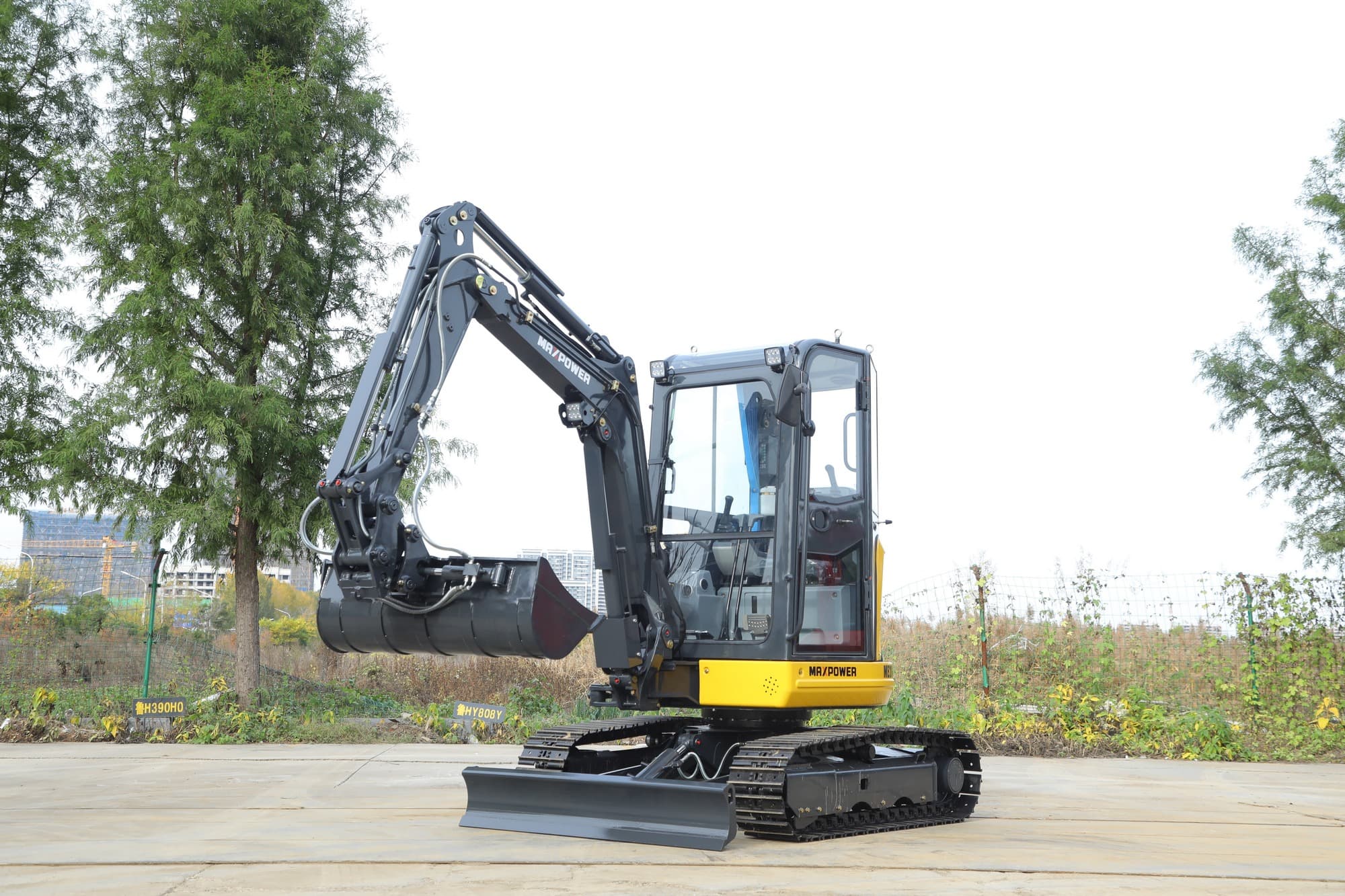
The published bucket capacity is 0.05 m³.
After checking access, describe the actual trench width, depth, material, and spoil-removal arrangement to MAXPOWER. Ask for the relevant working-range information rather than assuming a small bucket guarantees suitable digging depth.
For example, a short service trench and a large foundation excavation should not be evaluated from entrance width alone.
Send MAXPOWER photographs and measured dimensions of the full access route. Include overhead obstacles, turning areas, excavation requirements, and the proposed machine position.
For the electrical side, request the charging requirements for the supplied configuration. Identify where charging would take place without obstructing the access route.
Confirm the final specification in writing before arranging delivery.
The ME18EV’s published dimensions give buyers a concrete starting point for assessing restricted access. The decision still requires checks of width, height, turning space, supporting surfaces, and excavation requirements.
Match the complete machine to the complete route—not just the gate.
Share your entrance measurements, site photographs, and digging requirements with MAXPOWER. Request the ME18EV dimensional drawing, working-range information, and charging specification to check the proposed configuration before ordering.
The product page lists 950/1280 mm. Confirm the applicable configuration before planning access.
The cited parameter page does not establish that classification. Request its rear-swing dimensions.
The published height to the top of the cab is 2370 mm.
No. Operating clearance and the site layout require separate assessment.
Provide access dimensions, photographs, ground information, excavation requirements, and available electrical supply.







