Maxpower Construction Machinery Manufacturer




A larger excavator is worth considering when your existing machine cannot keep up with the work. But before placing an order, identify what is actually holding production back.
Is the excavator struggling to fill trucks quickly enough? Is difficult material slowing every digging cycle? Or does the machine spend much of its shift waiting for trucks to return?
Those situations lead to different purchasing decisions.
MAXPOWER lists the ME800 excavator with an operating weight of 76.5 tonnes and a 5 m³ bucket. These specifications make it a substantially different equipment proposition from a machine selected mainly for smaller, frequently changing construction jobs. Whether that capacity benefits your operation depends on how you will use it.
This guide explains how to evaluate the ME800 against your production requirements before committing to a particular configuration.
Start with a recent working shift rather than the product brochure.
Record how much material your current excavator moved, how long it spent actively digging, and how much time it spent waiting. Separate equipment limitations from delays elsewhere in the operation.
If trucks are consistently waiting while the excavator works continuously, greater excavation capacity deserves investigation. If the excavator waits between trucks, examine the hauling arrangement before increasing machine size.
Use the same approach when reviewing a new project. Establish the required daily output and the productive hours available to achieve it.
The reason to choose the ME800 should be an identified workload—not simply the availability of a larger machine.
Yes. A useful purchasing decision includes at least one credible alternative.
For example, MAXPOWER publishes the ME520 excavator at 51.5 tonnes, with a listed bucket-capacity range of 2.8–3.6 m³. Those figures provide a smaller option to evaluate alongside the ME800. They do not establish a fixed productivity difference between the two models.
Compare both against the same material, loading arrangement, and production target.
If the smaller option meets your required output under representative conditions, identify what additional work would justify the ME800. If it cannot, examine whether the larger machine addresses the limitation without creating another constraint in transport, access, or truck loading.
A bucket’s volume does not tell you its material payload.
Cubic metres measure volume. The mass carried depends on the material’s bulk density and how much material actually fills the bucket. Do not interpret a bucket-capacity figure as the same number of tonnes.
Provide MAXPOWER with the material description and available density information. Ask for the appropriate bucket configuration and its permitted operating limits.
Then compare representative bucket payloads with your trucks’ rated payloads and body dimensions. The objective is controlled loading without overloading or unnecessary material redistribution. HSE’s loading guidance emphasizes respecting vehicle limits and distributing loads appropriately.
This gives a fleet buyer a more useful answer than a general claim about how many passes should fill a truck.
The current ME800 page lists a Cummins QSM15 77C engine, rated at 563 kW at 2,000 rpm, and maximum hydraulic flow of 504 × 2 L/min.
Include these figures in the configuration confirmation, but do not treat them as guaranteed production output.
Ask for performance evidence that resembles your intended work. A demonstration in loose stockpiled material does not answer every question about excavating a resistant formation.
For an overseas order, also request the engine identification and supporting documents relevant to the supplied configuration and destination market. Keep that verification separate from the excavation-performance assessment.
The ME800’s published working equipment includes a 6,600 mm boom and a 2,900 mm arm. These component lengths are not, by themselves, maximum digging depth or dumping height.
Request the applicable working-range drawing and compare it with your proposed loading layout.
Show where the excavator will stand, the excavation level, and the truck’s body height. Ask whether the machine can perform the required movement without repeated repositioning or an unsuitable approach to the vehicle.
If suspended lifting is also part of the intended work, request the applicable lifting information and approved configuration. HSE treats excavator lifting as a separate activity requiring appropriate equipment selection and safeguards; operating weight is not a lifting-capacity rating.
The published overall width is 4,300 mm. That measurement matters before purchase, not only when the transporter arrives.
Have the proposed delivery route and working area assessed. Include the site entrance, corners, overhead restrictions, and any structures along the route.
HSE’s vehicle-route guidance calls for considering dimensions, loaded weight, maneuverability, and the supporting capacity of bridges and ramps.
For the purchasing decision, establish whether the machine can be deployed where its capacity is needed. If access requires changes, identify those requirements before final equipment approval.
Keep the transport arrangement in the discussion, but make it serve the purchase decision rather than become the entire reason for choosing a machine.
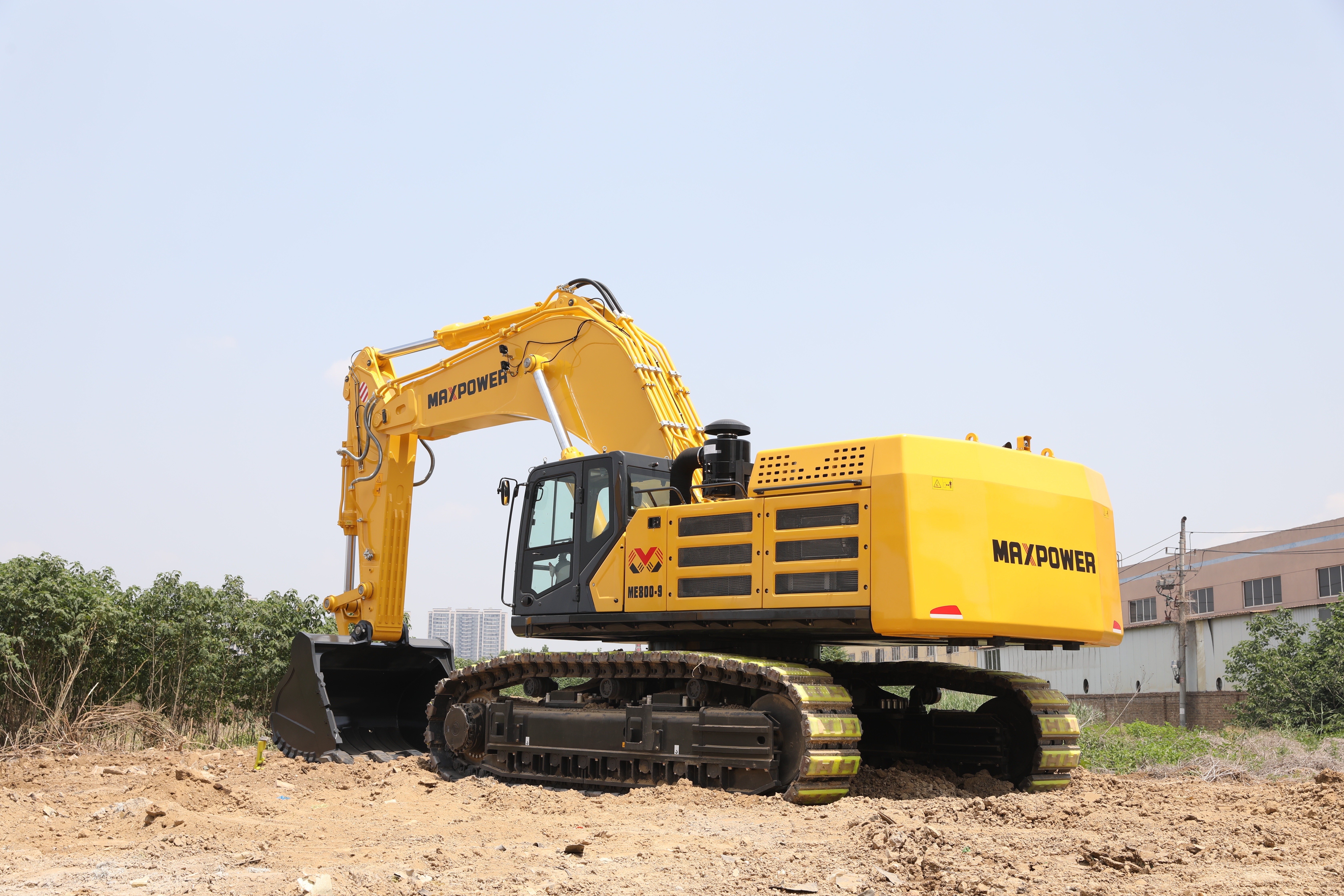
MAXPOWER describes the ME800 with automatic air conditioning and a spring-assisted hood opening. These are useful features to inspect during a visit or demonstration.
Bring the people who will operate and maintain the machine into the evaluation.
Ask the operator to assess the seating position, control access, and view of the intended work area. Have the maintenance team examine access to routine service points using the relevant instructions.
Do not turn a convenient hood opening into an unsupported promise of shorter repair times. Establish what the crew can actually inspect and service, and what requires specialist assistance.
HSE’s maintenance guidance emphasizes planning maintenance and providing competent personnel with adequate information. That is a purchasing consideration as well as an operating responsibility.
Ask how the supplied machine will be supported at your project location.
Discuss the maintenance documentation, parts-identification process, recommended initial service items, and technical contact arrangements. Request written warranty terms and clarify how a reported problem will be assessed.
For a remote operation, work through a realistic example: your maintenance team identifies a fault that it cannot resolve. Who receives the report? What information is required? How will the correct replacement component be identified?
Use MAXPOWER’s repair and maintenance service page to begin that conversation. Confirm the arrangements for your location rather than assuming that general service statements establish local stock or a particular response time.
Agree on the assessment before the demonstration begins.
Use a defined task, representative material, and the proposed machine configuration. Record completed work, elapsed time, waiting periods, and relevant operating conditions.
Watch whether the operator can fill and discharge the bucket consistently. Review the entire sequence rather than selecting the fastest individual cycle.
Arrange a suitable demonstration area with clear responsibilities and pedestrian separation. HSE recommends agreeing loading arrangements in advance when multiple parties are involved.
Afterward, compare the observations with your project requirements. Keep observed results separate from any performance commitments agreed with the supplier.
The purpose is to establish whether the offered ME800 configuration fits your work—not to reproduce a promotional video.
The final technical offer should describe the machine you assessed.
Identify the model, engine configuration, bucket, working equipment, and included options. Attach the relevant drawings and specify the documentation to accompany delivery.
Also clarify the dispatch arrangement, any assembly required at the destination, and responsibility for commissioning and handover.
For distributors purchasing several units, retain an approved configuration sheet for each order. Review proposed substitutions before acceptance instead of assuming that an unchanged model name means every supplied component remains identical.
A clear offer makes it easier to compare suppliers and verify the delivered equipment without relying on informal conversations.
Consider it when your operation has recurring excavation or loading work that may benefit from the machine’s published capacity, and when your hauling system, working area, and support arrangements can accommodate the proposed configuration.
Keep smaller options under consideration when they can meet the same production requirement or when frequent relocation and restricted access dominate your workload.
Before deciding, return to the original problem. Can the selected machine complete the required work within the available production window? Can the rest of the operation keep pace? Can your team support it?
Those answers are more useful than choosing the largest model in the MAXPOWER excavator range.
A useful ME800 purchasing assessment connects specifications to a real operating requirement.
Define the production target, evaluate the material, check truck compatibility, confirm the working range, and establish the support arrangements. Then use a representative demonstration and a written configuration to close the remaining gaps.
The right purchase is the machine that meets your workload with a workable deployment and support plan—not simply the one with the largest published figures.
No. Compare the proposed configurations against the same production requirement, material, access conditions, and hauling arrangement.
Not alone. Production assessment also needs representative payloads, cycle times, working conditions, and available productive hours.
Yes. Include payload ratings, body dimensions, and the proposed loading position so the equipment combination can be evaluated.
Request the confirmed configuration, relevant working-range information, operating and maintenance documents, warranty terms, and delivery responsibilities.
Combine your project data with a configuration review and a representative, safely arranged performance assessment.
Share your material, production target, truck specifications, and project location with MAXPOWER. Request a review of the ME800 excavator configuration and the supporting technical information before finalizing your equipment selection.







