Maxpower Construction Machinery Manufacturer




A backhoe loader passes through the site entrance without difficulty. Its bucket suits the trench, and its front loader can handle the materials. Then the crew prepares to excavate and discovers that the planned working position leaves insufficient room for the support arrangement.
That is a purchasing problem worth resolving before delivery.
For contractors comparing the MAXPOWER MEL880H and MEL880A, backhoe loader stabilizers deserve attention alongside digging and loading specifications. MAXPOWER identifies the MEL880H with an H-type stabilizer configuration and the MEL880A with an A-type configuration. These are distinct product arrangements, not interchangeable descriptions of the same machine.
The useful question is not which letter represents the better machine. It is which complete configuration fits the work your company performs regularly.
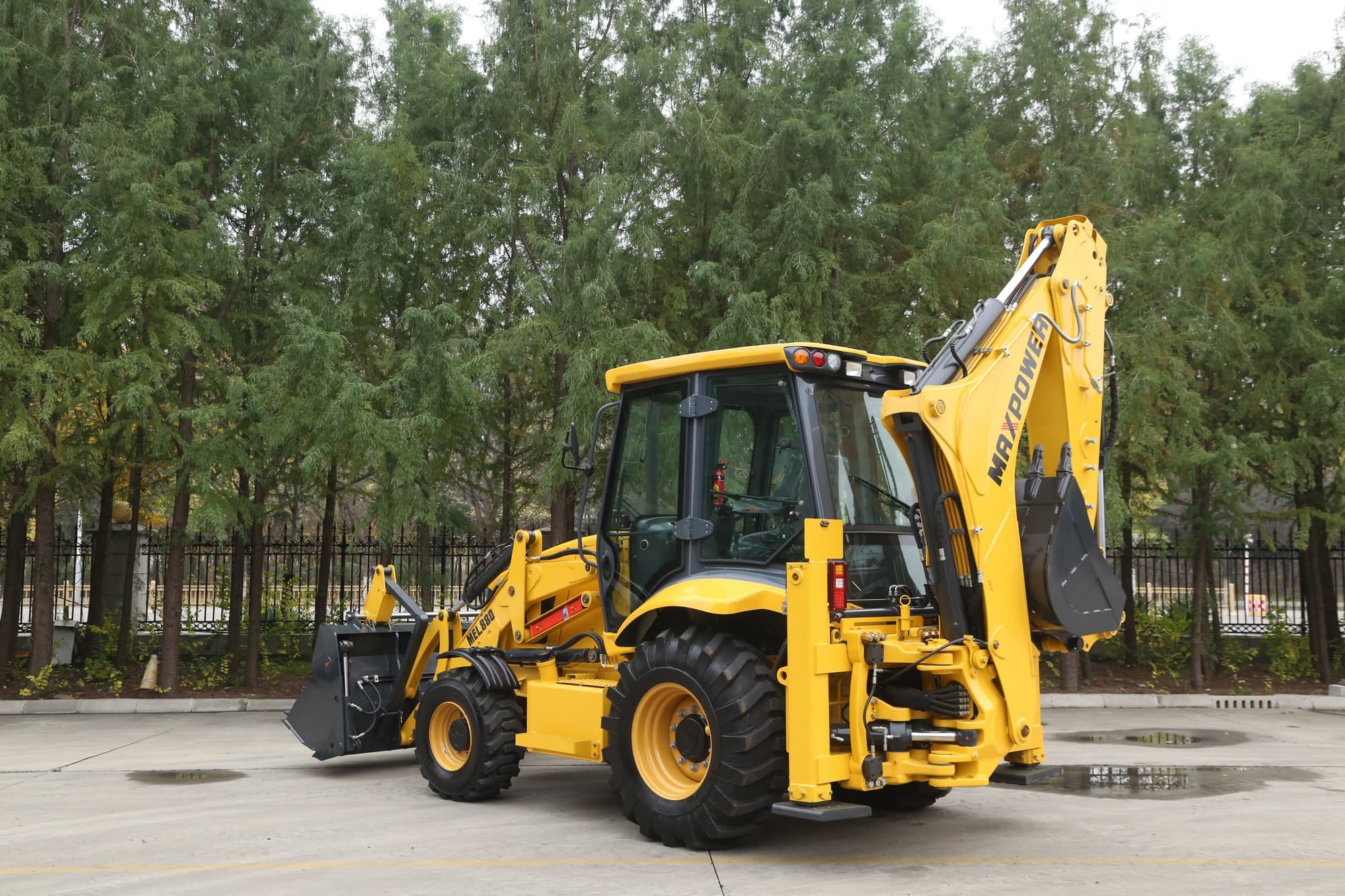
The published operating weight is 9,250 kg for the MEL880H and 8,800 kg for the MEL880A. Their listed transport widths also differ: 2,430 mm for the MEL880H and 2,360 mm for the MEL880A.
These figures give buyers a starting point for access and transport discussions. They do not establish the space occupied by the stabilizers during excavation.
When reviewing MAXPOWER backhoe loaders, keep each model’s information separate. Do not take the weight from one machine, the width from another, and assume the resulting combination describes the equipment being offered.
Request a configuration sheet identifying the exact model and supplied equipment.
Transport width describes the machine in its specified transport arrangement. The working footprint must also account for the support positions and movements required during excavation.
The published MEL880H and MEL880A parameter tables do not provide a fully deployed stabilizer-spread dimension. Consequently, neither listed transport width should be used as a substitute for that measurement.
Ask for drawings showing the stabilizers in their travel and approved working positions. Also establish whether different positions are permitted and how any operating restrictions change.
A machine that fits through the gate has passed the access check—not the excavation-layout check.
This distinction is especially useful when the same contractor works beside walls, temporary barriers, parked vehicles, or existing structures.
Start with a representative site rather than choosing an A-type or H-type arrangement from a photograph.
Give MAXPOWER a drawing of the available working area and ask how each proposed machine would be positioned. Include the trench, nearby structures, spoil location, and access needed by other workers.
Then compare the approved setups.
Does either arrangement require the working area to be reorganized? Can the machine reach the intended excavation from that position? Will the crew need to move barriers whenever the machine advances?
Do not assume that one stabilizer type always occupies less space or provides greater capacity. Request configuration-specific dimensions and operating information before drawing those conclusions.
Available space is only part of the assessment. The supporting surface also needs attention.
A paved area beside an existing trench, a recently backfilled utility corridor, and an undeveloped building site should not be treated as equivalent locations for positioning machinery.
HSE’s excavation safety guidance warns that additional loads from plant near excavation edges can increase the risk of collapse. It also identifies ground conditions, underground structures, and existing services as important planning information.
For an equipment inquiry, describe those conditions and arrange a competent site assessment where required. Ask the manufacturer for the support information needed by the person assessing the working platform.
A different set of backhoe loader stabilizers does not remove the need to establish whether the ground can support the operation.
The operating-weight difference does not, on its own, establish a digging-performance advantage.
Both product tables list a 1 m³ front-loader bucket and a 0.32 m³ rear digging bucket. Matching bucket capacities do not prove identical production, but they show why the comparison should extend beyond machine weight.
Assess the complete working sequence instead.
For a contractor handling short repair jobs, the relevant question may be how conveniently the machine can be positioned, prepared for excavation, and moved to its next task. For longer excavation work, useful reach and sustained digging performance may deserve more attention.
Request evidence for those requirements rather than treating additional operating weight as a guaranteed improvement.
Both published tables list a 2,500 kg rated load in the loading section. That entry should not be presented as the permitted suspended load at every position of the rear backhoe.
Keep front-loader work and rear lifting requirements separate in your inquiry.
If the machine will handle pipes or other suspended loads, describe the load, required position, and intended operation. Request the applicable lifting information and confirmation of the equipment needed for that task.
HSE’s excavator guidance treats equipment selection, operating precautions, and inspection as essential considerations. A headline capacity figure does not replace those checks.
The purchasing question is whether the supplied machine is suitable for the actual lift—not whether another part of its specification contains a sufficiently large number.
Ask to see the machine perform a complete, representative job.
For example, arrange a demonstration in which a trained operator positions the backhoe loader, prepares it according to the manufacturer’s instructions, excavates within a defined area, and returns it to the approved condition for repositioning.
Observe from a designated safe location. HSE emphasizes operator competence, adequate visibility, and keeping pedestrians outside machinery operating areas.
Pay attention to the details that affect your crew’s work. Can the operator see the relevant areas? Does the approved support position fit the proposed layout? Are repeated adjustments caused by machine configuration or by an unsuitable site arrangement?
Record preparation, excavation, and repositioning separately. This gives the purchasing team something more useful than a short video showing only the bucket digging.
Do not ask the operator to improvise a restricted stabilizer position to make the demonstration fit.
Review a selection of recent jobs before deciding which configuration to order.
A machine chosen entirely around one exceptionally narrow site may not be the most useful option for the rest of the year. Equally, repeatedly accepting difficult setup arrangements on ordinary jobs deserves attention during the next purchase.
Identify the restrictions that occur regularly.
Perhaps your crews frequently work between an excavation and a traffic barrier. Perhaps most work takes place on open sites, but the machine moves between several locations each day. These are different purchasing priorities.
Use that pattern to evaluate the MEL880H and MEL880A. The objective is to select backhoe loader stabilizers that fit the company’s recurring work, while recognizing which unusual projects require a different equipment plan.
Include the stabilizer system in the pre-purchase service discussion.
Request inspection instructions and parts-identification information for the supplied configuration. Ask how replacement components are identified and what information your maintenance team should provide when reporting a problem.
HSE recommends daily visual checks, regular inspections, and servicing based on manufacturer instructions and operating risks. Safety-critical defects require the equipment to be taken out of service until addressed.
For an overseas buyer, discuss these arrangements through MAXPOWER’s repair and maintenance contact before dispatch.
Clarify the process rather than assuming that a general after-sales statement establishes local stock, a particular response time, or interchangeability between MEL880H and MEL880A parts.
The technical offer should identify more than the backhoe loader family name.
Record the selected model, stabilizer configuration, supplied buckets, relevant dimensions, and operating documentation. Attach the agreed working-position drawing where it forms part of the equipment assessment.
Keep the demonstration configuration connected to the order. If the supplier proposes a change, review its effect on your original requirements before accepting it.
For distributors, retain a separate approved specification for each configuration sold. This makes it easier to explain the differences to customers and prevents a later order from being based on a mixture of information from two models.
The final offer should make the delivered machine easy to identify and check.
Keep both models under consideration until you have compared their approved working arrangements against your site requirements.
The MEL880H should not be selected simply because it is heavier. The MEL880A should not be selected simply because its published transport width is narrower. Neither figure answers the full operating-space question.
A more useful decision follows three checks: whether the machine can reach the working area, whether it can be positioned and supported appropriately, and whether it can complete the required excavation and loading tasks.
Where one configuration satisfies those requirements more comfortably, the reason for choosing it becomes clear. Where neither fits, revise the equipment plan instead of forcing the site to accommodate an unsuitable setup.
Backhoe loader stabilizers are part of the equipment purchase, not a detail to leave until the first day of excavation.
For the MEL880H and MEL880A, use the published specifications to establish the differences, then obtain the working-position information needed for your site assessment.
The right machine should fit the access route, the available operating area, and the work your crews perform regularly. That is a stronger basis for purchasing than choosing from stabilizer labels or operating weight alone.
MAXPOWER identifies the MEL880H with an H-type stabilizer configuration.
MAXPOWER identifies the MEL880A with an A-type stabilizer configuration.
No. Request the working-position drawing and applicable operating requirements for the supplied configuration.
Operating weight alone does not establish lifting capacity. Request the applicable ratings for the intended operation.
Provide the site layout, ground information, trench dimensions, loading requirements, and the restrictions your crews encounter most often.
Send MAXPOWER your site photographs, available working dimensions, and excavation requirements. Request a review of both configurations, including the stabilizer arrangement and supporting technical documentation, before finalizing your order.







